
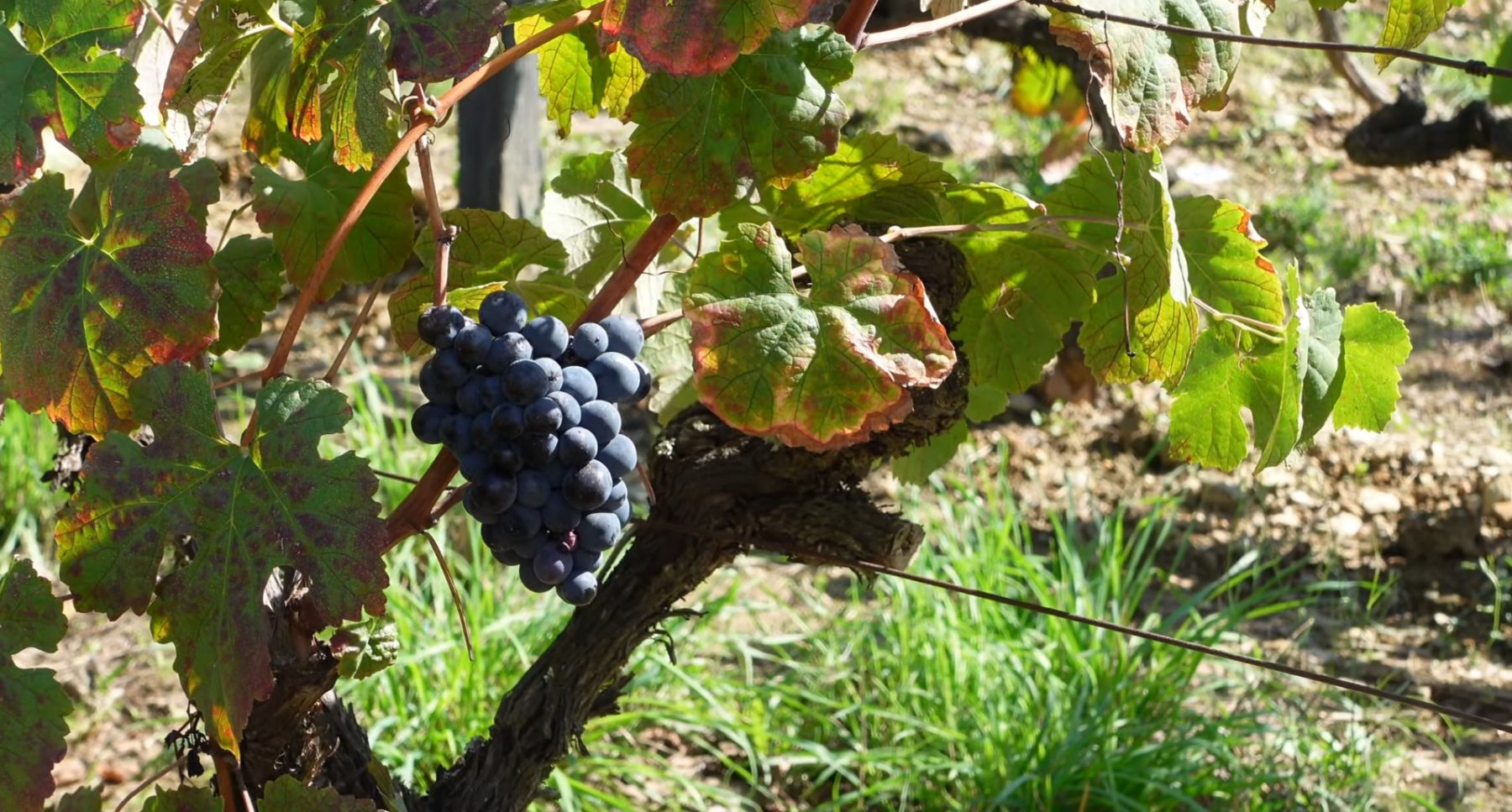
Portuguese wine can feel difficult before the first glass even reaches the table. The labels are full of names that do not behave like Chardonnay, Cabernet Sauvignon, Merlot, or Sauvignon Blanc. Touriga Nacional. Encruzado. Baga. Loureiro. Tinta Roriz in one region, Aragonez in another. It can look like a private language written for people who already know the answer.
That is also why Portuguese wine is so rewarding once the pattern becomes clear. The country is not built around one famous global grape. Its wine identity comes from native varieties, regional blends, old vineyard traditions, and grapes that make the most sense when tied to place. Portuguese wine grapes are less about memorizing a list and more about reading a map through flavor.
Touriga Nacional helps explain the structure and perfume of many serious red wines from the Douro and Dão. Alvarinho brings the fresh, citrus-charged side of northern Portugal into focus. Encruzado shows why Dão can make white wines with texture and aging potential. Baga is the stubborn, tannic soul of Bairrada. None of these grapes sits alone. They belong to regions, food, weather, soil, and local habits.
Portugal starts to make sense when the grape is not separated from the place. Touriga Nacional without the Douro or Dão is only half a clue; Alvarinho without Monção e Melgaço loses part of its northern bite.
What Are the Most Important Portuguese Wine Grapes?
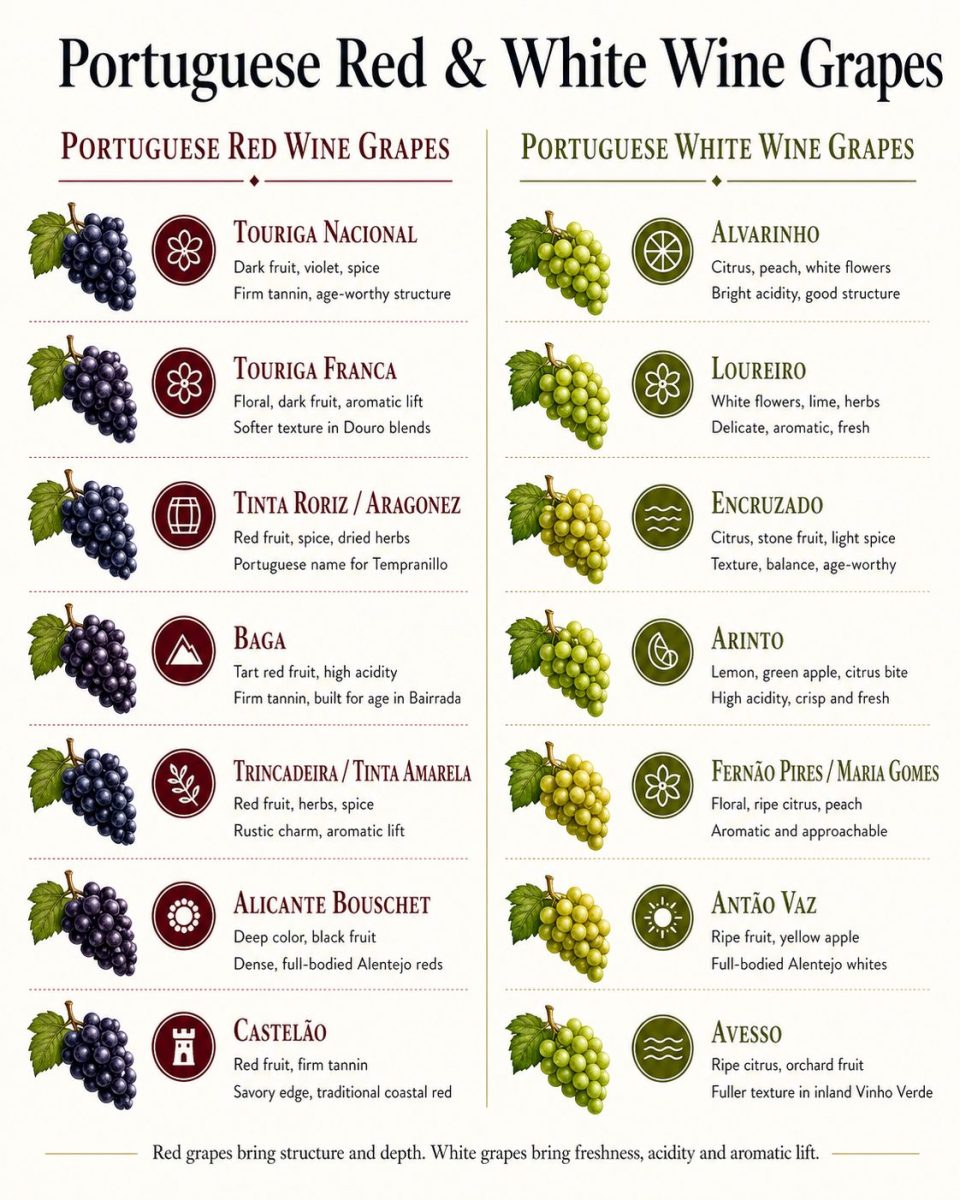
The most important Portuguese wine grapes include Touriga Nacional, Touriga Franca, Tinta Roriz, Baga, Trincadeira, Alvarinho, Loureiro, Encruzado, Arinto, Fernão Pires, Antão Vaz, and Avesso. Those names give you a strong working base for understanding Portuguese red and white wines.
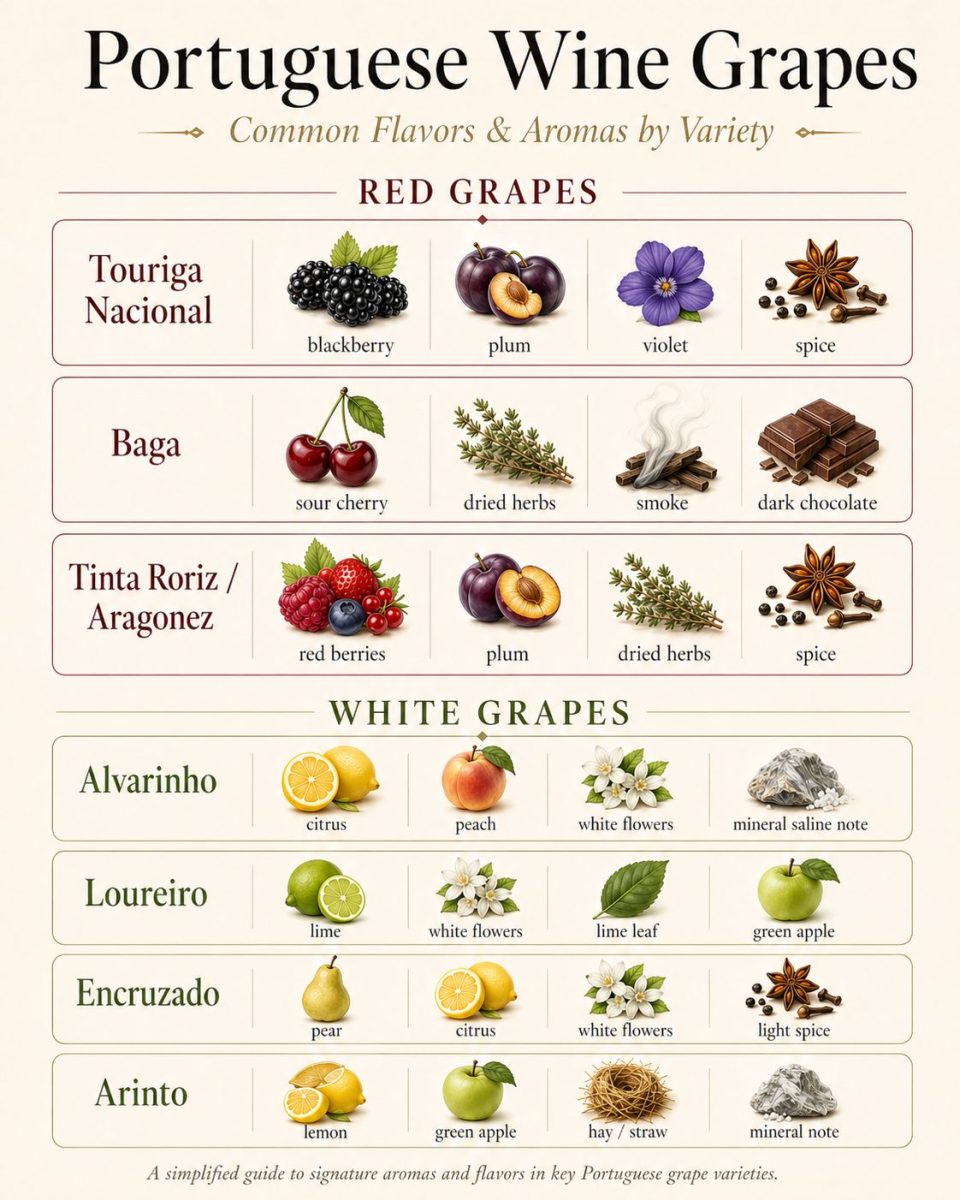
The quick rule is this: if you are looking at serious Portuguese reds, learn Touriga Nacional, Touriga Franca, Tinta Roriz, and Baga first. If you are looking at Portuguese whites, start with Alvarinho, Loureiro, Encruzado, Arinto, and Antão Vaz.
Portugal has far more grape varieties than most beginners need to know at once. Some are famous. Some hide inside blends. Some appear under different names depending on the region. A few are rare enough that even experienced wine drinkers may only meet them after years of tasting. No need to panic. Start with the names that explain the biggest styles.
| Grape | Red or White | Main Regions | Typical Style |
|---|---|---|---|
| Touriga Nacional | Red | Douro, Dão, Alentejo | Dark fruit, violet, tannin, structure |
| Touriga Franca | Red | Douro | Floral, dark-fruited, softer than Touriga Nacional |
| Tinta Roriz / Aragonez | Red | Douro, Dão, Alentejo | Red fruit, spice, firm structure |
| Baga | Red | Bairrada, Dão | High acidity, firm tannin, age-worthy red fruit |
| Trincadeira / Tinta Amarela | Red | Alentejo, Douro | Red fruit, herbs, spice, rustic edge |
| Alicante Bouschet | Red | Alentejo | Deep color, dense fruit, full body |
| Alvarinho | White | Vinho Verde, especially Monção e Melgaço | Citrus, peach, flowers, acidity, structure |
| Loureiro | White | Vinho Verde, especially Lima | White flowers, lime, herbs, delicate perfume |
| Encruzado | White | Dão | Texture, citrus, stone fruit, balance |
| Arinto | White | Bucelas, Lisboa, Vinho Verde, many regions | Lemon, sharp acidity, freshness |
| Fernão Pires / Maria Gomes | White | Tejo, Bairrada, Lisboa, Setúbal | Floral, aromatic, ripe citrus |
| Antão Vaz | White | Alentejo | Ripe fruit, body, warmth |
Why Portuguese Grape Varieties Can Feel Confusing
Portuguese grape varieties can feel confusing because Portugal does not organize wine in the same way many international drinkers expect. A bottle may be labeled by region rather than grape. A famous wine may be a blend of several native varieties. The same grape may use one name in the north and another name in the south. Then there are old field blends, where different varieties grow together in the same vineyard and are harvested together.
That sounds messy. In the glass, it often makes perfect sense.
Portugal Has a Deep Native Grape Culture
Portugal’s strength is its native grape diversity. Instead of replacing local varieties with a short list of international grapes, many regions kept their own names, habits, and blends. That is why Portuguese wine can taste so distinct even when the bottle price is modest.
For beginners, this is good news. You are not just tasting another version of the same global red or white. You are tasting something tied to Douro terraces, Dão granite, Bairrada limestone, Alentejo heat, Vinho Verde rain, or the Atlantic edge near Lisbon.
Many Portuguese Wines Are Blends
One of the first things to understand is that Portugal is a blend-first wine culture in many regions. That is especially true in the Douro, where port and dry red wines often rely on several grapes working together rather than one variety carrying the whole bottle.
Touriga Nacional might bring structure and perfume. Touriga Franca may add softer fruit and floral lift. Tinta Roriz can bring spice and firmness. Tinto Cão may add freshness and finesse. The result is not always about one superstar grape. It is about balance.
| Term | What It Means |
|---|---|
| Single-varietal wine | A wine focused mainly on one grape, such as Alvarinho, Encruzado, Baga, or Touriga Nacional. |
| Blend | A wine made from several grapes, common in regions such as Douro, Dão, and Alentejo. |
| Field blend | A traditional vineyard mix where different grape varieties grow together and may be harvested together. |
| Regional style | A wine shaped as much by place, climate, and local tradition as by the grape name itself. |
Some Grapes Have More Than One Name
Portuguese wine names can shift by region. This is not a trick. It is local history. The same grape may have one name in the Douro and another in Alentejo, or one name in Bairrada and another elsewhere.
| One Name | Another Name | What It Means |
|---|---|---|
| Tinta Roriz | Aragonez | Portuguese names for the grape better known internationally as Tempranillo |
| Fernão Pires | Maria Gomes | Aromatic white grape; Maria Gomes is especially common in Bairrada |
| Arinto | Pedernã | High-acid white grape; Pedernã appears in some northern contexts |
| Trincadeira | Tinta Amarela | Red grape known by different names in southern and northern contexts |
| Síria | Roupeiro | White grape with different regional names |
Once you know this, Portuguese labels become less intimidating. Tinta Roriz and Aragonez are not two mysteries. They are one grape wearing two regional coats.
Portuguese Red Wine Grapes
Portuguese red wine grapes shape some of the country’s most famous wines, from powerful Douro reds to elegant Dão blends, tannic Bairrada wines, and warm Alentejo reds. These grapes can produce very different styles depending on climate and region. A Touriga Nacional from Dão may feel more refined and floral. A Douro version can feel darker, firmer, and more muscular. The grape matters. So does the place.
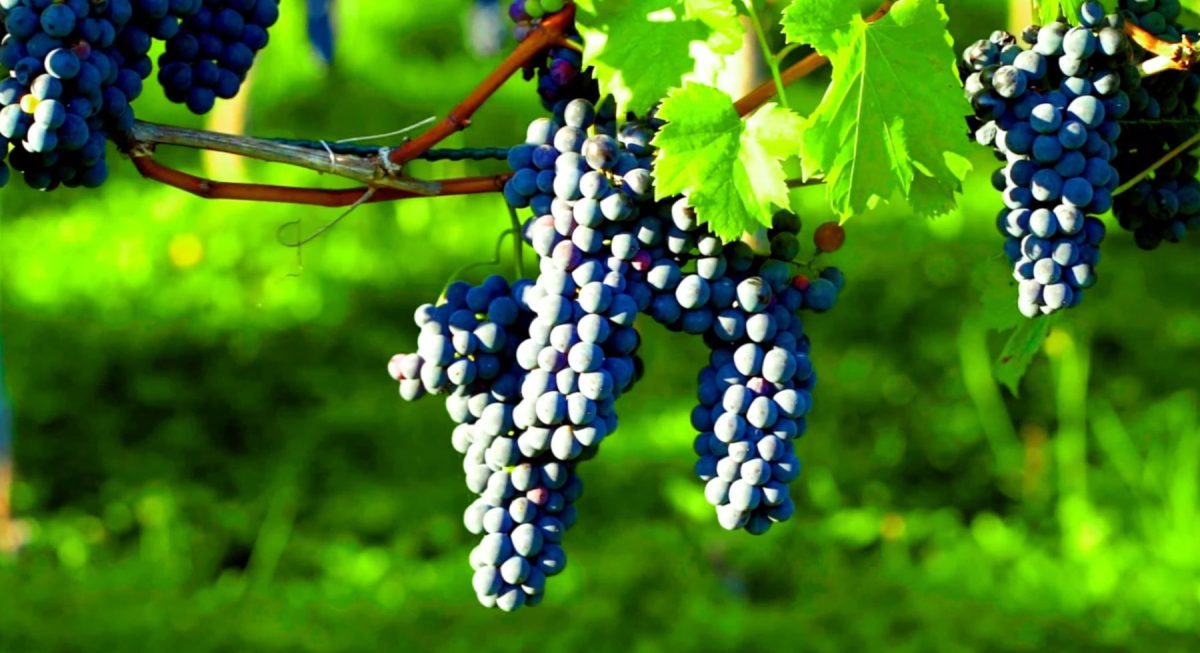
Start with the red grapes below. They explain most of what beginners need to know before moving into rarer names.
Touriga Nacional
Touriga Nacional is widely treated as Portugal’s flagship red grape. It is deeply associated with the Douro and Dão, though it now appears in many other Portuguese regions as well. In the glass, it often brings dark fruit, violet-like perfume, firm tannin, color, and structure.
This is the grape many people expect to behave like Portugal’s answer to Cabernet Sauvignon or Syrah. That comparison can help at first, but it is not exact. Touriga Nacional has its own signature: black fruit, floral intensity, grip, and a certain compact power. It can be impressive on its own, but it also performs beautifully in blends.
What Touriga Nacional Tastes Like
- Fruit: blackberry, black cherry, plum, sometimes blueberry.
- Aromas: violet, bergamot, herbs, dark spice.
- Structure: firm tannin, good color, strong aging potential.
- Best regions: Douro and Dão are the classic references.
- Food pairings: lamb, beef, grilled meats, aged cheese.
Touriga Nacional is important for port, but it should not be reduced to port. It is also central to many dry Portuguese red wines, especially where producers want depth, perfume, and structure.
Touriga Franca
Touriga Franca is less famous than Touriga Nacional, but it is one of the essential grapes of the Douro. If Touriga Nacional often supplies power and perfume, Touriga Franca can bring floral lift, dark fruit, and a rounder, more approachable shape.
This grape is especially useful for explaining Portuguese blends. It may not always shout from the label, but it can do important work inside the bottle. In Douro reds, it often helps soften the harder edges of more tannic grapes while keeping the wine aromatic and generous.
Tinta Roriz and Aragonez
Tinta Roriz and Aragonez are Portuguese names for Tempranillo. The name Tinta Roriz is common in northern regions such as the Douro and Dão, while Aragonez is more often used in southern areas such as Alentejo.
This grape is a helpful bridge for people who already know Spanish wine. In Portugal, it can bring red fruit, spice, structure, and a familiar savory edge. It rarely explains a whole Portuguese wine by itself, but it is an important part of many red blends.
Why Tinta Roriz Matters
- It connects Portuguese wine to the broader Iberian wine world.
- It adds structure and red-fruit character to blends.
- It appears in both northern and southern Portugal under different names.
- It is easier for beginners to understand once they know it is Tempranillo.
Baga
Baga is the grape that makes Bairrada impossible to ignore. It is not soft. It is not always friendly young. It can be tannic, acidic, firm, and a little severe before it has time to settle. That is part of the point.
Good Baga wine can age beautifully. It often shows tart red fruit, dried herbs, earth, smoke, and a tight structure that relaxes with time. Poorly handled Baga can feel hard and unforgiving. Well-handled Baga has nerve.
What Baga Wine Tastes Like
- Fruit: sour cherry, red currant, cranberry, sometimes darker fruit with age.
- Structure: high acidity and firm tannin.
- Regional home: Bairrada is the key region.
- Aging: better examples can improve with bottle age.
- Food pairings: roast suckling pig, pork, duck, fatty meats.
Baga is a useful grape for wine drinkers who like Nebbiolo, Sangiovese, or other red wines where acidity and tannin matter as much as fruit. It is not the easiest Portuguese red grape. It may be one of the most rewarding.
Trincadeira and Tinta Amarela
Trincadeira, also known as Tinta Amarela in some northern contexts, is a red grape associated with red fruit, herbs, spice, and a sometimes rustic personality. It appears in Alentejo and the Douro, among other regions.
This grape can be charming, but it is not always simple in the vineyard. It can be sensitive and inconsistent. In good hands, it adds aroma, freshness, and a savory edge. In blends, it often gives Portuguese reds a more herbal, less obvious fruit profile.
Alicante Bouschet
Alicante Bouschet is not originally Portuguese, but it has become deeply important in Alentejo. It is a teinturier grape, meaning its flesh is red as well as its skin. That gives wines deep color and density.
In Alentejo, Alicante Bouschet can produce dark, full-bodied reds with black fruit, weight, and a rich texture. It is the grape to know when a Portuguese red looks almost black in the glass and tastes broad, warm, and powerful.
Castelão
Castelão is a traditional red grape found in areas such as Península de Setúbal, Lisboa, and Tejo. It can produce wines with red fruit, firm tannin, and a dry, savory edge. It does not have the prestige of Touriga Nacional or the cult appeal of Baga, but it belongs in a serious guide because it explains many everyday Portuguese reds.
Castelão can feel rustic in the right way: honest fruit, grip, and enough structure for grilled food.
Jaen and Alfrocheiro
Jaen and Alfrocheiro are especially useful for understanding Dão reds. Jaen often brings juicy fruit and freshness. Alfrocheiro can add color, berry fruit, and spice. Neither needs to dominate the label to matter.
Dão is often about elegance rather than brute force, and these grapes help explain that. Alongside Touriga Nacional and Tinta Roriz, they contribute to wines that can feel lifted, fragrant, and less heavy than many Douro or Alentejo reds.
Tinto Cão
Tinto Cão is a small but respected player, especially in the Douro. The name means “red dog,” which people remember, but the grape itself is more graceful than the name suggests. It can bring freshness, spice, and finesse to blends.
This is not usually the first Portuguese grape beginners need to memorize. It is one of the names that makes the article feel properly Portuguese rather than generic.
Portuguese Red Wine Grapes at a Glance
| Grape | Main Regions | Taste Profile | What to Know |
|---|---|---|---|
| Touriga Nacional | Douro, Dão, Alentejo | Black fruit, violet, spice, firm tannin | Portugal’s flagship red grape |
| Touriga Franca | Douro | Floral, dark fruit, rounder texture | Essential blending grape in Douro |
| Tinta Roriz / Aragonez | Douro, Dão, Alentejo | Red fruit, spice, structure | Portuguese name for Tempranillo |
| Baga | Bairrada, Dão | Tart red fruit, tannin, high acidity | Can make long-lived reds |
| Trincadeira / Tinta Amarela | Alentejo, Douro | Red fruit, herbs, spice | Useful but sensitive grape |
| Alicante Bouschet | Alentejo | Deep color, dark fruit, density | Important in Portugal, though not originally native |
| Castelão | Setúbal, Lisboa, Tejo | Red fruit, firm tannin, savory edge | Traditional southern and coastal red grape |
| Jaen | Dão | Juicy fruit, freshness, softer structure | Adds lift to Dão reds |
| Alfrocheiro | Dão, Alentejo | Berry fruit, spice, color | Good supporting grape for blends |
| Tinto Cão | Douro | Freshness, spice, finesse | Small but respected role in blends |
Portuguese White Wine Grapes
Portuguese white wine grapes are just as important as the reds, though they often receive less attention outside Portugal. That is a mistake. The country makes everything from razor-sharp Atlantic whites to textured Dão wines, warm Alentejo whites, mineral Douro blends, aromatic Vinho Verde, and serious bottles that can age far better than people expect.
The easiest way to understand Portuguese whites is to separate freshness from texture. Alvarinho, Loureiro, and Arinto explain much of Portugal’s crisp northern and coastal identity. Encruzado, Antão Vaz, Avesso, Rabigato, and Viosinho show that Portuguese white wine can be broader, more structured, and more food-driven.
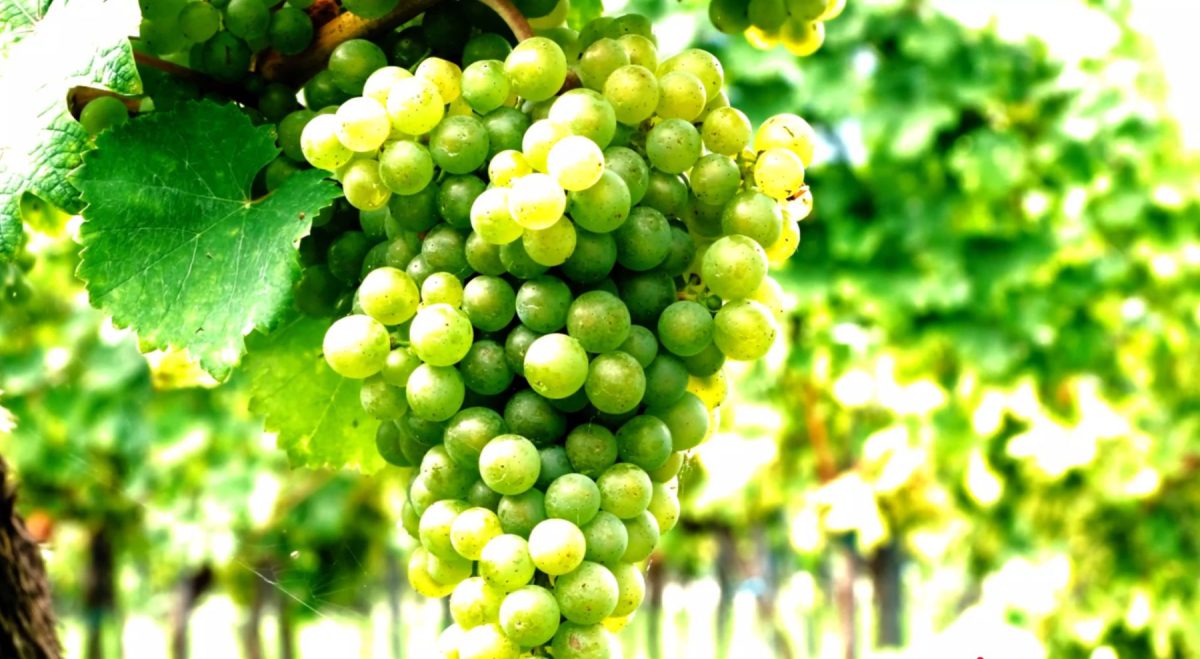
Alvarinho
Alvarinho is Portugal’s most internationally recognizable white grape, especially because of its link to Vinho Verde and the Monção e Melgaço subregion. It is the Portuguese counterpart to Spain’s Albariño, but the best Portuguese examples deserve to be judged on their own terms.
Good Alvarinho is not just light and refreshing. It can have citrus peel, peach, apricot, white flowers, saline freshness, and enough body to make it work with proper food. In Monção e Melgaço, where the climate is warmer and more sheltered than many other parts of Vinho Verde, Alvarinho can become fuller and more structured.
What Alvarinho Tastes Like
- Fruit: lime, lemon peel, peach, apricot, sometimes green melon.
- Aromas: white flowers, herbs, light saline notes.
- Structure: bright acidity with more body than many simple Vinho Verde wines.
- Best regions: Vinho Verde, especially Monção e Melgaço.
- Food pairings: grilled fish, prawns, octopus, goat cheese, roast chicken.
Alvarinho is the white grape to learn first if you want a clean entry point into Portuguese white wine. It is familiar enough to be approachable, but serious enough to keep rewarding attention.
Loureiro
Loureiro is another essential Vinho Verde grape, but it speaks more softly than Alvarinho. It is floral, lifted, fragrant, and often beautifully suited to the green river valleys of northwest Portugal. The name is linked to laurel, and the wines can carry a gentle herbal edge beneath the citrus and blossom.
In the Lima Valley, Loureiro can feel almost weightless without being empty. White flowers, lime, lemon balm, fresh herbs, a cool finish. It is not the grape for drinkers who want power. It is the grape for people who notice perfume.
Encruzado
Encruzado is the Portuguese white grape that too many beginners discover late. That is a shame, because it may be one of the country’s best arguments for serious white wine. Its home is Dão, where granite soils, altitude, and a more restrained climate can produce whites with balance, texture, and aging potential.
Encruzado does not usually shout. It works through structure: citrus, pear, stone fruit, light spice, sometimes a waxy or creamy texture, and a calm mineral line. With oak, it can become broader and more layered. Without oak, it can still feel complete.
Why Encruzado Wine Matters
- It shows that Portugal makes serious white wines beyond Vinho Verde.
- It can age better than many casual drinkers expect.
- It gives Dão a strong white-wine identity, not only a red-wine one.
- It pairs well with richer food than very light Portuguese whites.
If Alvarinho is the obvious Portuguese white grape to try first, Encruzado is the one that makes people rethink the category.
Arinto
Arinto is one of Portugal’s great acidity grapes. It appears in many regions, including Bucelas, Lisboa, Vinho Verde, and beyond. In some northern contexts, it may also be known as Pedernã.
Arinto usually brings lemon, green apple, sharp acidity, and a clean, firm finish. It can work as a single-varietal wine, but it is also valuable in blends because it keeps warmer-climate whites from feeling heavy. Think of it as a backbone grape. Not always glamorous. Very useful.
Fernão Pires and Maria Gomes
Fernão Pires, also known as Maria Gomes in Bairrada, is one of Portugal’s most widely planted aromatic white grapes. It can produce wines with orange blossom, ripe citrus, peach, and sometimes tropical fruit. It is expressive, easy to notice, and often approachable young.
The danger is that it can become too soft or blowsy if acidity is not handled carefully. At its best, Fernão Pires gives perfume and charm. In blends, it can add the aromatic lift that a sharper grape like Arinto balances out.
Antão Vaz
Antão Vaz belongs strongly to Alentejo. If Vinho Verde whites often feel cool and brisk, Antão Vaz tends to show the opposite side of Portugal: sun, ripe fruit, body, and warmth. It can give wines with tropical fruit, yellow apple, citrus, and a rounder mouthfeel.
This is not usually a razor-edged white. It works best when the producer keeps freshness intact and avoids letting the wine become too heavy. Good Antão Vaz can be generous without turning dull.
Avesso
Avesso is one of the grapes that proves Vinho Verde is not only about light, spritzy whites. It is especially associated with Baião and more inland parts of the region, where it can produce fuller, more textured wines.
Avesso can bring ripe citrus, orchard fruit, body, and a food-friendly shape. It is less famous than Alvarinho and less floral than Loureiro, but it gives Vinho Verde a broader voice. For wine drinkers who think the region is too simple, Avesso is useful evidence against that idea.
Rabigato, Viosinho, and Gouveio
Rabigato, Viosinho, and Gouveio are important white grapes in the Douro and surrounding northern regions. They often appear in blends rather than as famous stand-alone names, but they help explain why Douro whites have become more interesting in recent years.
- Rabigato: brings citrus, freshness, and a mineral edge.
- Viosinho: adds floral notes, stone fruit, and texture.
- Gouveio: can contribute body, fruit, and balance.
These grapes matter because the Douro is no longer only a red-wine and port story. Its white wines can be tense, mineral, and surprisingly serious when grown at altitude and handled with restraint.
Bical
Bical appears in Bairrada and Dão, and it can be important in both still and sparkling wines. It usually brings citrus, orchard fruit, and moderate acidity, though its personality depends heavily on region and winemaking.
Bical is not the loudest Portuguese white grape. It is one of those names that becomes more useful once you start exploring beyond the obvious bottles.
Portuguese White Wine Grapes at a Glance
| Grape | Main Regions | Taste Profile | What to Know |
|---|---|---|---|
| Alvarinho | Vinho Verde, especially Monção e Melgaço | Citrus, peach, flowers, acidity, structure | Portugal’s best-known premium white grape |
| Loureiro | Vinho Verde, especially Lima | White flowers, lime, herbs | Floral and aromatic northern white grape |
| Encruzado | Dão | Citrus, stone fruit, texture, balance | One of Portugal’s most serious white grapes |
| Arinto / Pedernã | Bucelas, Lisboa, Vinho Verde | Lemon, acidity, freshness | Excellent acidity grape for blends and age-worthy whites |
| Fernão Pires / Maria Gomes | Tejo, Bairrada, Lisboa, Setúbal | Floral, ripe citrus, peach | One of Portugal’s common aromatic whites |
| Antão Vaz | Alentejo | Ripe fruit, body, tropical edge | Key grape for fuller southern whites |
| Avesso | Vinho Verde, especially Baião | Texture, ripe citrus, fuller body | Shows Vinho Verde’s more serious inland side |
| Rabigato | Douro | Citrus, mineral edge, freshness | Important in Douro white blends |
| Viosinho | Douro, Trás-os-Montes | Floral, stone fruit, texture | Adds aroma and body to white blends |
| Bical | Bairrada, Dão | Citrus, orchard fruit, moderate acidity | Useful in still and sparkling wines |
Portuguese Wine Grapes by Region
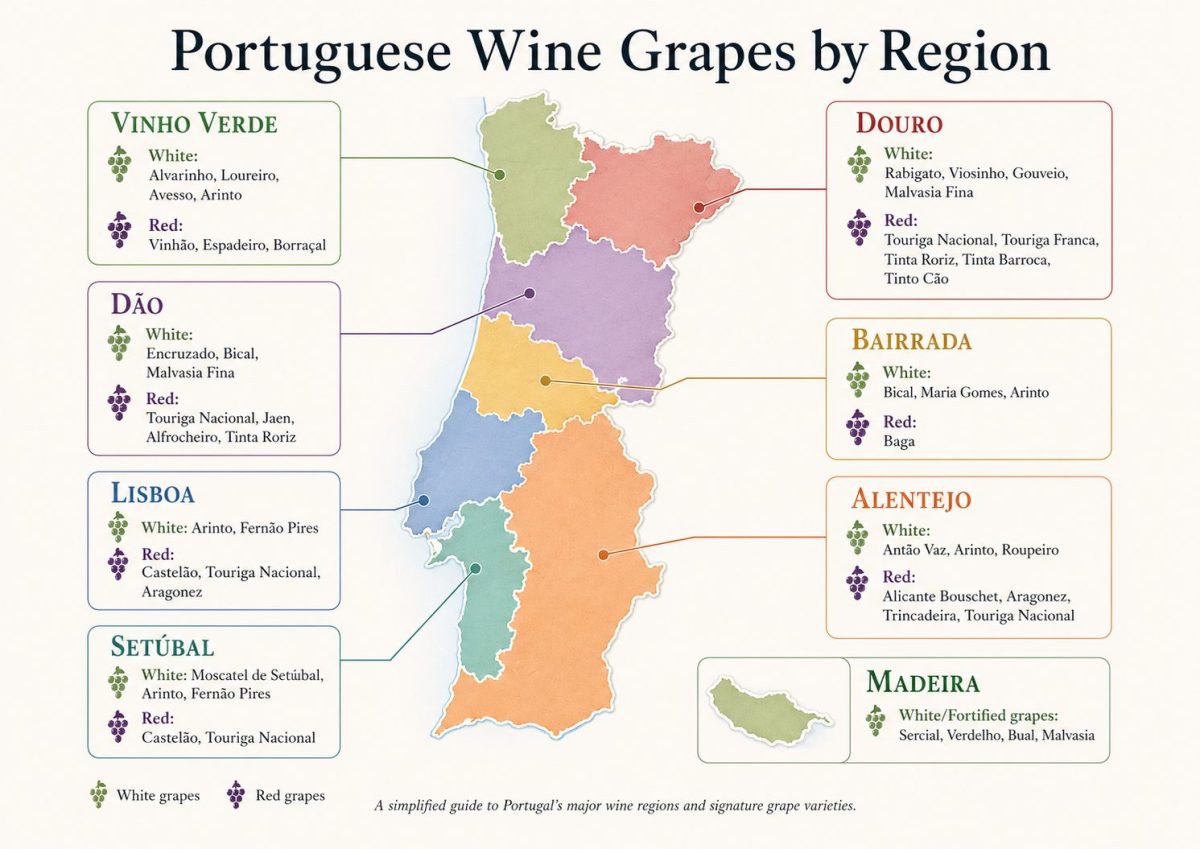
Portuguese grapes make the most sense when they are attached to regions. A grape name on its own tells you part of the story. The place fills in the rest. Touriga Nacional from Dão is not the same experience as Touriga Nacional from the Douro. Alvarinho from Monção e Melgaço has a different shape from a lighter Vinho Verde blend. Baga without Bairrada loses its sharpest context.
| Region | Key Red Grapes | Key White Grapes | Style to Expect |
|---|---|---|---|
| Douro | Touriga Nacional, Touriga Franca, Tinta Roriz, Tinta Barroca, Tinto Cão | Rabigato, Viosinho, Gouveio, Malvasia Fina | Powerful reds, port grapes, increasingly serious whites |
| Dão | Touriga Nacional, Jaen, Alfrocheiro, Tinta Roriz | Encruzado, Bical, Malvasia Fina | Elegant reds and structured whites |
| Vinho Verde | Vinhão, Espadeiro, Borraçal | Alvarinho, Loureiro, Avesso, Arinto, Trajadura, Azal | Fresh whites, aromatic grapes, crisp acidity |
| Bairrada | Baga | Bical, Maria Gomes, Arinto | Tannic reds, sparkling wines, high-acid whites |
| Alentejo | Alicante Bouschet, Aragonez, Trincadeira, Touriga Nacional | Antão Vaz, Arinto, Roupeiro | Warm, generous reds and fuller whites |
| Lisboa and Bucelas | Castelão, Touriga Nacional, Aragonez | Arinto, Fernão Pires | Fresh whites, coastal reds, strong value wines |
| Setúbal | Castelão, Touriga Nacional, Aragonez | Moscatel, Fernão Pires, Arinto | Muscat wines, savory reds, coastal freshness |
| Colares | Ramisco | Malvasia de Colares | Rare coastal wines from sandy soils |
Douro Grapes
The Douro is famous for port, but its dry red wines have become just as important for many modern drinkers. Touriga Nacional, Touriga Franca, Tinta Roriz, Tinta Barroca, and Tinto Cão form much of the classic red-grape language here. The wines can be dark, structured, spicy, and built around blends rather than one grape acting alone.
White Douro wines deserve attention too. Rabigato, Viosinho, Gouveio, and Malvasia Fina can create fresh, mineral, sometimes textured whites, especially from higher-altitude vineyards.
Dão Grapes
Dão often gives Portuguese wine a more restrained, elegant voice. Touriga Nacional grows here too, but it does not always feel as muscular as it can in the Douro. Jaen, Alfrocheiro, and Tinta Roriz add fruit, spice, and lift.
For white wine, Encruzado is the key name. It gives Dão a serious white-wine identity and can make bottles with enough balance to age.
Vinho Verde Grapes
Vinho Verde is the region to understand if you care about fresh Portuguese white wine. Alvarinho, Loureiro, Avesso, Arinto, Trajadura, and Azal all play roles here. Alvarinho is the serious northern star, especially in Monção e Melgaço. Loureiro brings floral lift. Avesso gives more body in inland areas such as Baião.
Red Vinho Verde exists too, often from grapes such as Vinhão, but it remains more local in appeal than the region’s whites.
Bairrada Grapes
Bairrada is Baga country. That is the simple version, and it is mostly the useful one. Baga gives the region its firm, tannic, high-acid red wines. These wines can be challenging young, but the better ones age into something savory and complex.
Bairrada also produces sparkling wine, and white grapes such as Bical, Maria Gomes, and Arinto matter more than casual drinkers may realize.
Alentejo Grapes
Alentejo is warmer, broader, and often easier for beginners to enjoy. Red grapes such as Alicante Bouschet, Aragonez, Trincadeira, and Touriga Nacional can produce generous wines with ripe fruit and softer edges. Antão Vaz is one of the key white grapes, often giving fuller wines with ripe fruit and body.
This is the region to mention when someone wants Portuguese wine that feels generous rather than sharp or austere.
How to Read Portuguese Wine Labels by Grape
Portuguese wine labels can be confusing because they may highlight the region, the producer, the estate, the blend, or the grape. Sometimes the grape is obvious. Sometimes it is hidden in the technical notes on the back label. Sometimes the most important clue is not the grape at all, but the DOC or regional name.
The practical rule: read the region first, then the grape if it is shown. A Dão red tells you to expect a different structure than an Alentejo red. A Vinho Verde white tells you to expect freshness, but Alvarinho from Monção e Melgaço points toward a fuller, more serious version. A Bairrada red often warns you to expect Baga’s acidity and tannin.
Label Clues That Help
- DOC or region name: often tells you the style before the grape does.
- Single grape name: useful when you see Alvarinho, Encruzado, Touriga Nacional, or Baga clearly listed.
- Blend language: common in Douro, Dão, and many traditional regions.
- Regional grape names: remember that Tinta Roriz and Aragonez are the same grape.
- Producer notes: back labels sometimes explain the grape mix better than the front label.
Which Portuguese Grapes Should Beginners Try First?
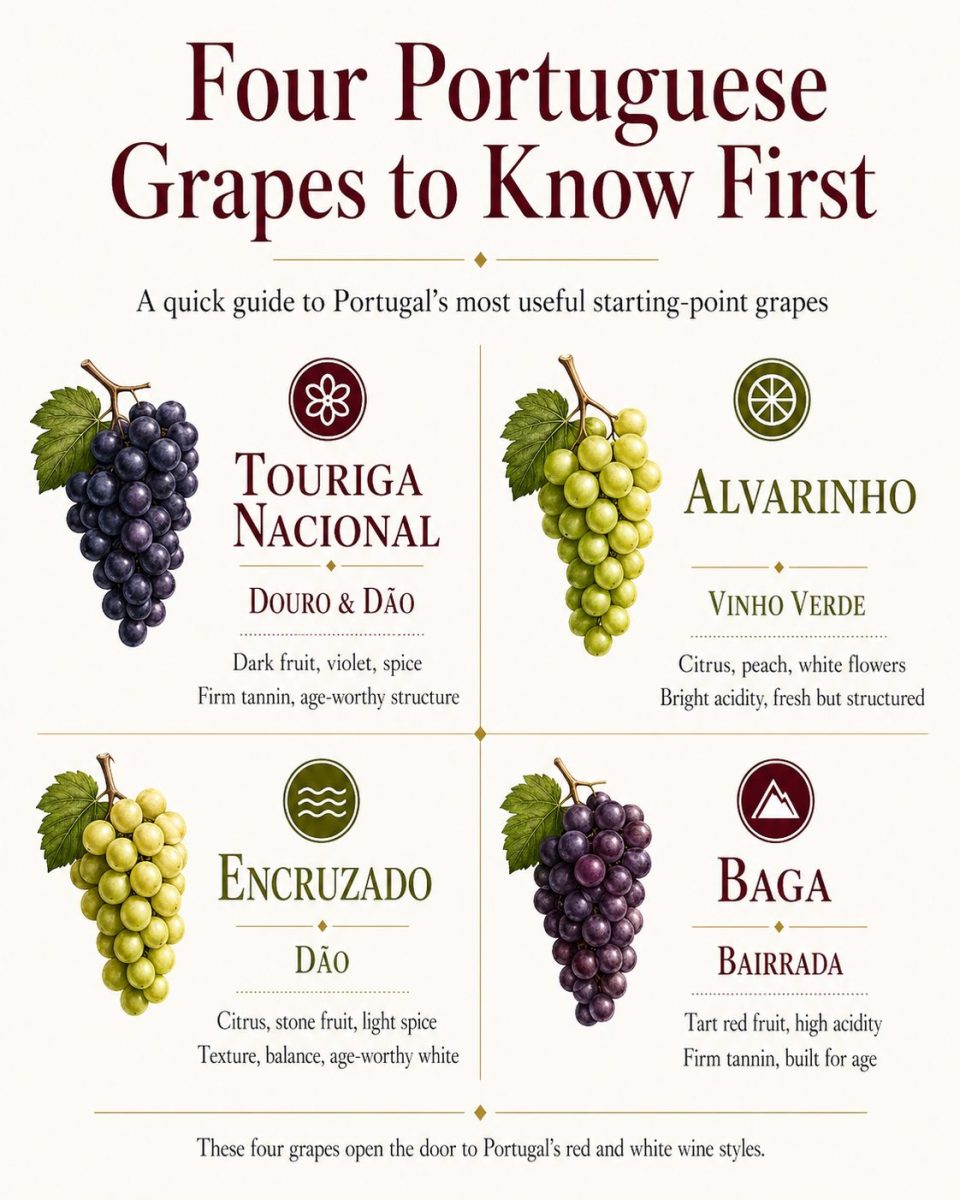
Beginners do not need to learn every Portuguese grape at once. Start with the varieties that explain the biggest differences in style. Try Alvarinho for freshness, Encruzado for textured white wine, Touriga Nacional for structured red wine, and Baga if you want something more tannic and old-school.
| If You Like | Try This Portuguese Grape | Why |
|---|---|---|
| Cabernet Sauvignon or Syrah | Touriga Nacional | Dark fruit, tannin, structure, intensity |
| Tempranillo | Tinta Roriz / Aragonez | It is the Portuguese name for the same grape |
| Albariño | Alvarinho | Same grape family, especially strong in northwest Portugal |
| Chablis or high-acid whites | Arinto | Citrus, acidity, freshness |
| White Burgundy | Encruzado | Texture, balance, and aging potential |
| Nebbiolo or Sangiovese | Baga | High acidity, tannin, and age-worthy structure |
| Aromatic whites | Loureiro or Fernão Pires | Floral perfume and bright fruit |
| Warm-climate full whites | Antão Vaz | Body, ripe fruit, and southern Portuguese warmth |
A Simple Beginner Tasting Set
If you want to learn Portuguese grapes quickly, buy four very different bottles rather than four similar ones. The contrast will teach you more than a long list of names.
- Alvarinho from Vinho Verde: for citrus, freshness, and northern white-wine structure.
- Encruzado from Dão: for texture, balance, and serious Portuguese white wine.
- Touriga Nacional blend from Douro or Dão: for dark fruit, perfume, and tannin.
- Baga from Bairrada: for acidity, grip, and age-worthy red-wine character.
Portuguese Wine Grapes and Food Pairings
Portuguese grapes make more sense with food. That sounds obvious, but it matters here because many local wines were shaped around regional tables. High-acid whites with seafood. Firm reds with pork and lamb. Baga with fatty meat. Alvarinho with octopus. Encruzado with richer fish or roast chicken.
| Grape | Best Pairings | Why It Works |
|---|---|---|
| Alvarinho | Seafood, grilled fish, octopus, goat cheese | Acidity and citrus lift salty, coastal dishes |
| Loureiro | Shellfish, salads, light starters, fresh cheese | Floral freshness works with delicate food |
| Encruzado | Roast chicken, cod, richer fish, creamy dishes | Texture and balance handle more weight |
| Arinto | Fried snacks, oysters, grilled sardines, lemony fish | Sharp acidity cuts oil and salt |
| Touriga Nacional | Lamb, beef, grilled meats, aged cheese | Tannin and dark fruit need protein and fat |
| Baga | Roast suckling pig, pork, duck, fatty meats | High acidity cuts richness |
| Antão Vaz | Chicken, pork, baked fish, richer vegetable dishes | Riper southern fruit and body support fuller dishes |
| Alicante Bouschet | Steak, lamb, stews, smoked meats | Deep color, density, and dark fruit suit powerful food |
Common Mistakes When Learning Portuguese Grapes
The biggest mistake is trying to memorize every grape before drinking anything. Portuguese wine is too regional for that. Learn the anchor grapes, taste them in context, and let the smaller names come later.
Mistake 1: Thinking Portugal Is Only About Port
Port is historically important, and the Douro grapes behind it matter. But Portugal also makes dry reds, dry whites, sparkling wines, rosé, Madeira, Moscatel, and many regional styles that have nothing to do with sweet fortified wine.
Mistake 2: Ignoring White Grapes
Many people discover Portuguese wine through red blends, then forget the whites. That misses Alvarinho, Encruzado, Loureiro, Arinto, Antão Vaz, Avesso, and Douro white blends. Portugal’s white wines are not a side note.
Mistake 3: Treating Every Grape as a Solo Performer
Some grapes shine alone. Alvarinho, Encruzado, Baga, and Touriga Nacional often can. But many Portuguese wines are blends, and that is not a weakness. It is part of the country’s wine logic.
Mistake 4: Forgetting Regional Names
Tinta Roriz and Aragonez are the same grape. Fernão Pires and Maria Gomes are the same grape. Trincadeira and Tinta Amarela can refer to the same variety. Once you know that, the label language becomes less irritating.
Mistake 5: Buying Only the Familiar Grapes
If you only buy Touriga Nacional and Alvarinho, you will learn something useful but narrow. Add Encruzado, Baga, Loureiro, Arinto, Antão Vaz, Avesso, and a Douro white blend. Portugal opens up quickly after that.
FAQ About Portuguese Wine Grapes
What are the main Portuguese wine grapes?
The main Portuguese wine grapes to know first are Touriga Nacional, Touriga Franca, Tinta Roriz, Baga, Trincadeira, Alvarinho, Loureiro, Encruzado, Arinto, Fernão Pires, Antão Vaz, and Avesso. These varieties explain many of Portugal’s major red and white wine styles.
What is the most famous Portuguese red grape?
Touriga Nacional is usually considered the most famous Portuguese red grape. It is important in the Douro, Dão, port production, and many dry red blends. It often brings dark fruit, violet aromas, tannin, color, and structure.
What is the most famous Portuguese white grape?
Alvarinho is probably the most famous Portuguese white grape internationally, especially because of its role in Vinho Verde and Monção e Melgaço. It produces fresh, citrusy, aromatic white wines with good acidity and structure.
Is Touriga Nacional only used for port?
No. Touriga Nacional is important for port, but it is also widely used in dry Portuguese red wines. It can appear as a single-varietal wine or as part of blends in regions such as Douro, Dão, and Alentejo.
Is Alvarinho the same as Albariño?
Alvarinho is the Portuguese name for the grape known as Albariño in Spain. The grape is strongly associated with northwest Iberia, especially Vinho Verde in Portugal and Galicia in Spain. Portuguese Alvarinho, especially from Monção e Melgaço, can be fuller and more structured than simple fresh whites.
What is Encruzado wine?
Encruzado wine is white wine made from the Encruzado grape, most strongly associated with Portugal’s Dão region. It can produce textured, balanced, age-worthy white wines with citrus, stone fruit, mineral notes, and sometimes a creamy or lightly waxy texture.
What does Baga wine taste like?
Baga wine often tastes of tart red fruit, sour cherry, red currant, herbs, earth, and spice. It usually has high acidity and firm tannins, especially when young. The best Baga wines from Bairrada can age well and develop savory complexity.
What grapes are used in Vinho Verde?
Important Vinho Verde grapes include Alvarinho, Loureiro, Avesso, Arinto, Trajadura, and Azal for white wines. Red Vinho Verde may use grapes such as Vinhão, Espadeiro, and Borraçal, though white Vinho Verde is far better known internationally.
What grapes are used in Douro wine?
Douro red wines often use Touriga Nacional, Touriga Franca, Tinta Roriz, Tinta Barroca, and Tinto Cão. Douro white wines may use Rabigato, Viosinho, Gouveio, Malvasia Fina, and other local grapes.
Are Portuguese wines usually blends?
Many Portuguese wines are blends, especially in regions such as Douro, Dão, and Alentejo. Single-varietal wines also exist and are increasingly common, especially with grapes such as Alvarinho, Encruzado, Touriga Nacional, and Baga.
Which Portuguese grape should beginners try first?
For white wine, start with Alvarinho if you like fresh, citrusy styles, or Encruzado if you want more texture. For red wine, start with Touriga Nacional if you like structured reds, or Baga if you enjoy high-acid, tannic wines with aging potential.
Why do some Portuguese grapes have two names?
Some Portuguese grapes have different names because regional traditions developed separately. Tinta Roriz is also called Aragonez, Fernão Pires is also called Maria Gomes, and Trincadeira may be called Tinta Amarela. These naming differences are normal in Portuguese wine.
Final Thoughts on Portuguese Wine Grapes
Portuguese grape names look difficult until you stop treating them as a vocabulary test. They are more useful as signposts. Touriga Nacional points toward structure and perfume. Alvarinho points toward fresh northern white wine. Encruzado points toward serious Dão whites. Baga points toward tannin, acidity, and Bairrada’s stubborn charm.
The real trick is connecting grape to region. Douro blends do not taste like Dão blends. Alentejo reds do not move like Bairrada reds. Vinho Verde whites do not behave like Encruzado from Dão. That regional logic is the reason Portuguese wine stays interesting long after the first unfamiliar label stops looking strange.
Learn a few anchor grapes, taste them in the right places, then let the smaller names find you. Portugal rewards that kind of patience.