
Vinho Verde is one of those names travelers think they already understand. A pale bottle. A cold glass. A little fizz. Something easy with seafood on a hot afternoon in Portugal. That version exists, and there is nothing wrong with it when the sun is sharp and the plate in front of you smells of grilled sardines and lemon.
But the Vinho Verde wine region is much larger, older, wetter, greener, and more complicated than that single supermarket image suggests. It spreads across northwest Portugal, through river valleys, granite soils, small farms, old trellised vines, historic towns, and the border country near Spain. Some wines are light and spritzy. Others, especially serious Alvarinho Vinho Verde from Monção and Melgaço, have weight, texture, citrus bite, and enough structure to make you stop treating the region as a summer cliché.
This is not Douro with dramatic schist terraces and port-wine history. It is not Porto’s lodge culture across the river in Vila Nova de Gaia. Vinho Verde belongs to the Atlantic north: rain-washed, intensely green, sometimes misty, always shaped by water. The wines carry that place in their bones.
Quick Answer: What Is Vinho Verde?
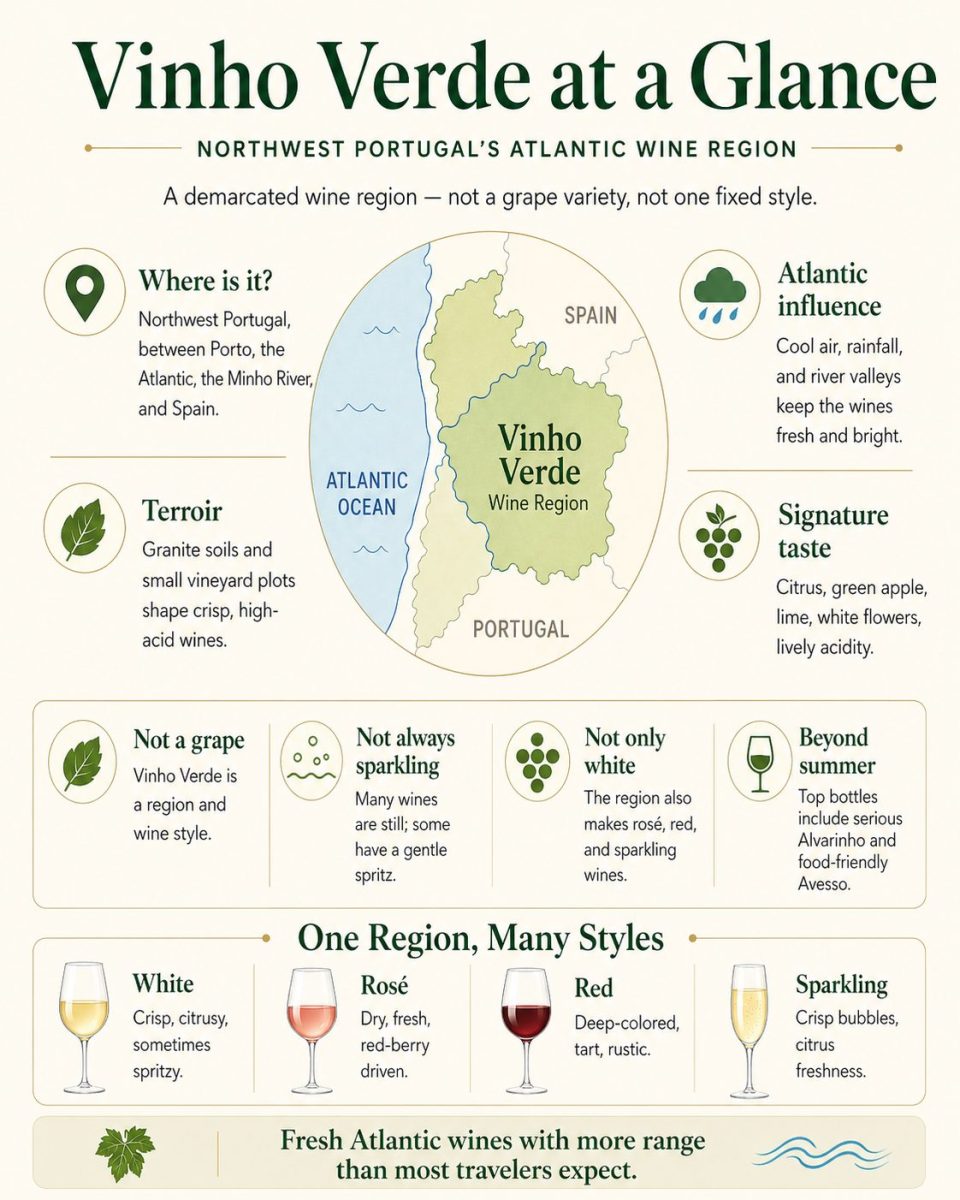
Vinho Verde is a wine region and DOC in northwest Portugal, not a single grape variety or one fixed wine style. The name means “green wine,” but that does not mean the wine is literally green. It usually refers to the fresh, youthful character of the wines and the lush green landscape of the Minho area.
Most people know Vinho Verde as a light, crisp white wine with bright acidity and sometimes a gentle spritz. That is the common international version. The real region is broader. It produces white, rosé, red, and sparkling wines, using grapes such as Alvarinho, Loureiro, Avesso, Arinto, Trajadura, Azal, and Vinhão.
The key point is simple: Vinho Verde is a place first, a wine style second.
Once you understand that, the region starts to make more sense. A cheap, lightly fizzy white from a supermarket shelf is only one doorway into Vinho Verde. Behind it sits Monção e Melgaço with its richer Alvarinho, Lima with its floral Loureiro, Baião with Avesso, and a whole patchwork of river valleys where the Atlantic still has a say in almost every bottle.
Where Is Vinho Verde From?
Vinho Verde comes from northwest Portugal, in the historic Minho and Entre-Douro-e-Minho area. The region stretches from the Minho River on the Spanish border down toward the area south of Porto, with the Atlantic Ocean influencing the western side and inland valleys creating subtle differences in style.
For travelers, Porto is usually the easiest gateway. You can land at Porto Airport, stay in the city, and reach parts of Vinho Verde wine country on a day trip. That said, the best parts of the region do not all sit conveniently beside Porto. Monção and Melgaço, the great Alvarinho territory near the Spanish border, require more time and better planning.
A useful way to picture the region is this:
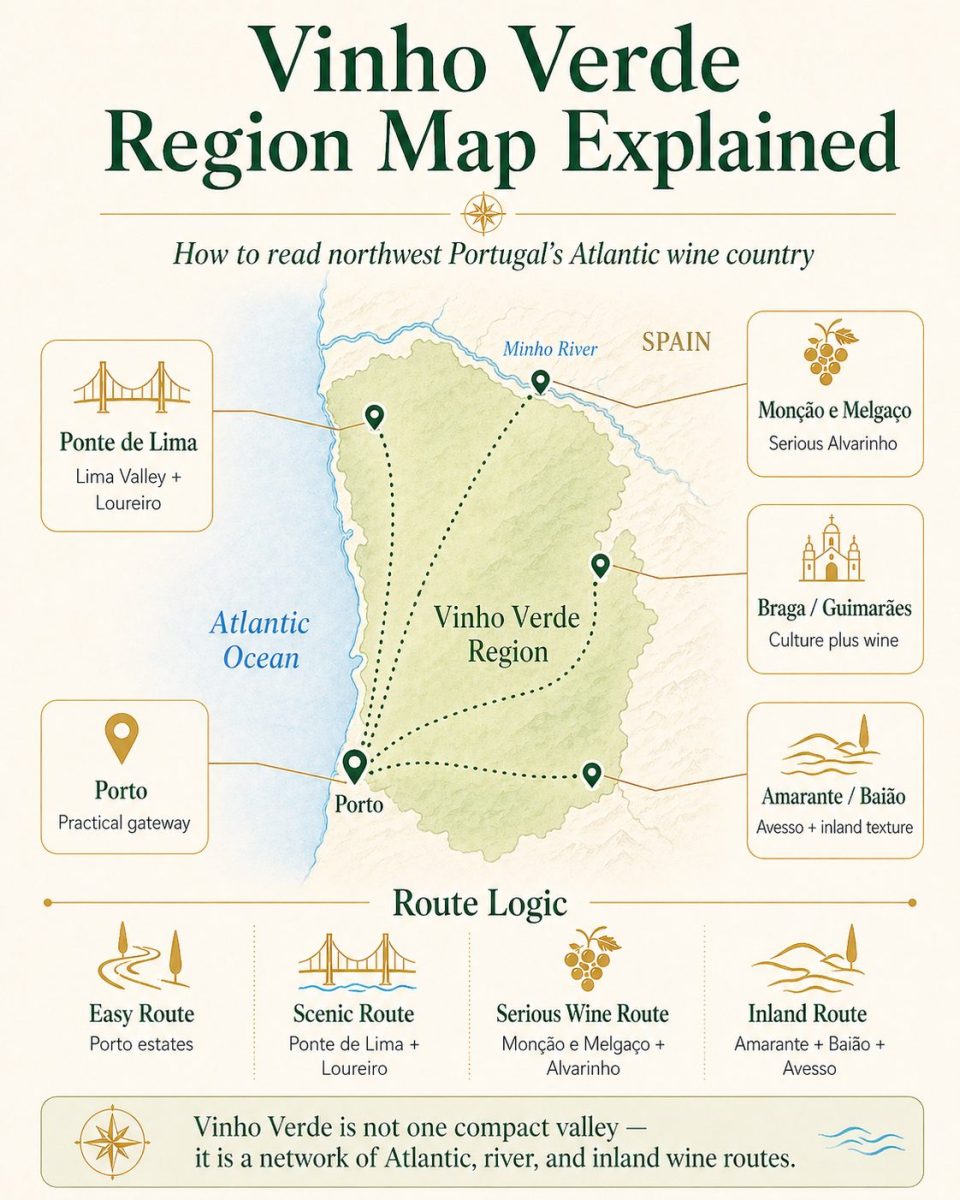
- Porto works as the practical entry point.
- Braga and Guimarães make good cultural bases for nearby Vinho Verde areas.
- Ponte de Lima brings you into Loureiro country and one of the prettiest river-town settings in northern Portugal.
- Monção and Melgaço are the names to know if you care about Alvarinho.
- Amarante and Baião show the more inland, textured side of the region.
So when someone asks, “Where is Vinho Verde from?” the short answer is northwest Portugal. The better answer is: from the wet granite valleys between Porto, the Atlantic, the Minho River, and the Spanish border.
Vinho Verde Wine Region Map Explained
A Vinho Verde wine region map can look confusing at first because this is not one compact valley. It is a wide, irregular region spread across northwest Portugal, with different river systems, towns, and subregions. The map starts to feel clearer when you stop looking at it as one block and begin reading it as a set of routes.
| Area | Best Known For | Travel Use |
|---|---|---|
| Porto and nearby estates | Easy introduction to Vinho Verde styles | Best for first-time visitors with limited time |
| Braga and Cávado | Fresh regional whites and cultural stops | Good for combining wine with historic sightseeing |
| Ponte de Lima and Lima Valley | Loureiro, floral white wines, river scenery | One of the most scenic ways to understand the region |
| Monção and Melgaço | Alvarinho with more body and structure | Best for serious wine travelers |
| Amarante and Baião | Avesso, inland whites, transitional landscapes | Good for travelers who want depth beyond the obvious route |
The Atlantic side tends to emphasize freshness, high acidity, and lighter styles. The inland areas can show more body and ripeness, especially where hills and river valleys protect vineyards from the coldest ocean influence. Monção e Melgaço is the classic example. It still belongs to Vinho Verde, but its wines do not behave like the simplest beachside whites people associate with the name.
That is why a map matters. It explains the gap between a light bottle of Vinho Verde poured at a café in Porto and a serious Alvarinho tasted near the Minho River. Same region. Different mood entirely.
Why Vinho Verde Tastes So Fresh
The freshness of Vinho Verde is not an accident of winemaking. It starts in the landscape. Northwest Portugal is green because it is wet. Atlantic winds push moisture inland. Rain falls often enough to shape farming, architecture, vineyard training, and the whole feeling of the place. Even in summer, the region can feel less parched than other Portuguese wine areas.
Granite is another part of the story. Much of the region sits on granite-based soils, which tend to support wines with clean acidity and a firm mineral line. That does not mean every Vinho Verde tastes like wet stone. Wine is never that tidy. But when you taste a good white from the region, especially one with citrus tension and a cool finish, the connection between climate, soil, and style is not hard to feel.
The region’s rivers also matter. The Minho, Lima, Cávado, Ave, Sousa, and other waterways help organize the landscape. Vineyards often sit around these valleys rather than forming the kind of grand, continuous vineyard panorama you see in the Douro. Vinho Verde is more fragmented. Small plots. Farmhouses. Vines near vegetable gardens. Old pergolas. A road bends, and suddenly there is a strip of vineyard tucked beside a stone wall.
The Atlantic Character of Vinho Verde
Many Portuguese wine regions are hot, dry, and sun-heavy. Vinho Verde is different. Its Atlantic character gives the wines their snap: lower alcohol in many classic examples, sharp citrus notes, green apple, lime peel, white flowers, and a kind of mouthwatering edge that works beautifully with seafood.
That is why Vinho Verde has become so popular outside Portugal. It is easy to drink, easy to chill, and easy to understand at first sip. But the best bottles are not merely “refreshing.” They have place. Loureiro can smell like white blossoms and herbs after rain. Alvarinho from Monção e Melgaço can bring ripe citrus, stone fruit, almond skin, and a firmer texture. Avesso can feel broader and more food-driven.
The mistake is treating freshness as simplicity. In Vinho Verde, freshness is the base layer. What happens above it depends on grape, subregion, producer, and ambition.
Vinho Verde Is Not Just a Summer Wine
The easy cliché says Vinho Verde is for summer. Cold bottle, terrace table, seafood lunch. Fair enough. A bright white Vinho Verde with grilled fish is one of Portugal’s simplest pleasures.
Still, the region should not be boxed into warm-weather drinking only. Fuller Alvarinho can work with roast chicken, richer cod dishes, pork, aged cheese, and more serious restaurant cooking. Loureiro can be delicate but not dull. Avesso has enough body to move beyond the aperitif role. Even red Vinho Verde, though less familiar to many visitors, has a local food culture behind it.
So yes, Vinho Verde can be the wine you drink very cold by the sea. It can also be the reason to leave Porto for a day, drive north through green hills, and taste how different Portugal becomes when the Atlantic is no longer just scenery but the main force in the glass.
The Nine Vinho Verde Subregions
Vinho Verde is not a single strip of vineyard country with one flavor. The region is divided into nine official subregions, and they matter more than casual drinkers usually realize. Some areas lean sharp and Atlantic. Others feel warmer, broader, more inland. A bottle from Monção e Melgaço can taste like it belongs to a different conversation than a light Loureiro-led wine from Lima.
This is where the region becomes interesting. Not harder. Just less lazy.
| Subregion | Main Wine Identity | Best Travel Angle |
|---|---|---|
| Monção e Melgaço | Structured Alvarinho with more body, ripeness, and depth | The strongest choice for serious wine travelers |
| Lima | Floral, aromatic Loureiro with bright freshness | Ideal for Ponte de Lima and river scenery |
| Cávado | Fresh white blends shaped by Atlantic influence | Useful for Braga-based wine routes |
| Ave | Light, crisp wines with easy northern character | Good when pairing Guimarães with wine tasting |
| Basto | More sheltered inland styles, sometimes fuller and rustic | Better for countryside travel than quick tasting stops |
| Amarante | Historic inland identity with white and red Vinho Verde styles | Strong choice for travelers who want a real town, not only a winery |
| Baião | Avesso and more textured white wines near the Douro transition | Best for visitors who already know basic Vinho Verde and want depth |
| Sousa | Traditional Minho landscape and fresh regional blends | Secondary route, useful for context |
| Paiva | Lesser-known inland character | Niche mention for completeness and expert depth |
Why the Subregions Matter
The subregions explain why Vinho Verde can feel so different from bottle to bottle. A coastal-influenced white may be lean, citrusy, lightly spritzy, and built for immediate drinking. A serious Alvarinho from Monção e Melgaço may carry ripe peach, lime oil, a firm mineral line, and enough texture to sit at the table with proper food.
That difference is not branding. It is geography.
- Closer to the Atlantic: wines often feel lighter, sharper, and more obviously refreshing.
- Further inland: wines can show more ripeness, texture, and body.
- River valleys: they create local pockets of climate rather than one uniform regional style.
- Granite soils: they help support the bright, firm acidity many drinkers associate with the region.
Monção e Melgaço: The Serious Side of Vinho Verde
If there is one subregion that deserves extra space in a Vinho Verde wine region guide, it is Monção e Melgaço. This is the northern borderland of Vinho Verde, close to Spain, shaped by the Minho River and protected from the direct force of the Atlantic. The wines are still fresh, but they are not fragile.
This is where Alvarinho Vinho Verde becomes more than a simple summer pour. In Monção and Melgaço, Alvarinho can be fuller, riper, more aromatic, and more structured than the lighter white wines many travelers expect from the region. Good examples can bring citrus peel, apricot, peach skin, white flowers, herbs, and a dry mineral finish. Some have a quiet almond note with age.
It is still Vinho Verde. Just with shoulders.
Why Alvarinho Performs So Well Here
Monção e Melgaço sits in a different climatic pocket from the wetter, more directly Atlantic areas of the region. The area has more shelter, better ripening conditions, and enough warmth to give Alvarinho concentration without losing the acidity that keeps the wine alive.
- More body: wines often feel broader than classic light Vinho Verde.
- Higher aromatic intensity: citrus, stone fruit, flowers, and herbal notes can be more pronounced.
- Better food range: these wines work with richer fish, roast chicken, pork, cod, and soft cheeses.
- More aging potential: top examples can develop texture and complexity instead of fading quickly.
Monção and Melgaço for Travelers
For wine travelers, Monção and Melgaço are worth the extra effort. They are not the easiest stops if you are trying to squeeze a quick tasting between Porto sightseeing and dinner reservations. The reward is a more focused wine experience: small towns, borderland scenery, Alvarinho-focused tastings, and a stronger sense of why Vinho Verde should not be dismissed as merely light or fizzy.
This is the route to choose when the wine matters more than convenience.
| Traveler Type | Is Monção e Melgaço Worth It? | Why |
|---|---|---|
| First-time visitor with one free afternoon | Usually not ideal | The distance can make the day feel rushed |
| Wine-focused traveler | Yes | This is the key area for serious Alvarinho |
| Couple wanting a scenic private wine day | Yes | The route feels more personal and less obvious |
| Traveler staying in Porto only | Possible, but better as a full day | It needs planning, not a casual last-minute outing |
| Visitor combining Portugal and Galicia | Excellent choice | The Minho borderland makes sense culturally and geographically |
Lima and Loureiro: The Floral Side of Vinho Verde
If Monção e Melgaço gives Vinho Verde its serious Alvarinho reputation, Lima gives the region one of its most graceful white-wine personalities. This is Loureiro country. The wines can be aromatic, floral, citrusy, and quietly herbal, with a lighter frame than many Alvarinho examples.
Ponte de Lima is the town most travelers should know here. It has the kind of river setting that makes northern Portugal feel older than the itinerary says: stone bridge, slow water, green banks, low clouds when the weather turns. Loureiro fits that landscape. It is not a loud grape. It works by perfume and lift.
What Loureiro Tastes Like
- White flowers: one of the classic markers of good Loureiro.
- Lime and lemon balm: citrus freshness without heavy weight.
- Green herbs: subtle herbal lift, especially in cleaner, cooler examples.
- Light body: usually more delicate than richer Alvarinho.
- Clean finish: a fresh, dry ending that works well with seafood and salads.
Loureiro is the grape to mention when the article needs softness, aroma, and scenery. Alvarinho may be the serious headline act, but Loureiro often feels more immediately tied to the green Minho landscape.
Baião, Avesso, and the Inland Texture of Vinho Verde
Baião is important because it helps break another lazy assumption: that all Vinho Verde is sharp, light, and built only for aperitif drinking. This area, closer to the transition toward the Douro, is associated with Avesso, a grape that can bring more body and texture.
Avesso does not usually have the same easy name recognition as Alvarinho or Loureiro. That is exactly why it is useful in a serious article. It shows that Vinho Verde has an inland, gastronomic side. The wines can feel broader, less perfumed, and more suited to the table.
Why Avesso Matters
- It gives Vinho Verde more weight and food-pairing range.
- It helps explain the inland parts of the region.
- It offers a useful contrast to Loureiro’s perfume and Alvarinho’s structure.
- It adds expert depth without making the article feel academic.
For travelers who have already tasted the obvious bottle of Vinho Verde, Baião and Avesso offer a better second chapter.
Main Grapes in the Vinho Verde Wine Region
The grape varieties of Vinho Verde are one of the easiest ways to understand the region. Some bring perfume. Some bring acidity. Some bring body. A few are used mostly in blends, doing quiet work in the background.
| Grape | Color | Typical Character | Where It Fits Best |
|---|---|---|---|
| Alvarinho | White | Citrus, stone fruit, flowers, structure, fuller body | Monção e Melgaço and premium Vinho Verde |
| Loureiro | White | Floral, lime, herbs, delicate perfume | Lima Valley and aromatic white wines |
| Avesso | White | Textured, fuller, food-friendly | Baião and inland styles |
| Arinto / Pedernã | White | High acidity, lemon, sharp freshness | Blends that need brightness |
| Trajadura | White | Softer fruit, rounder texture, less acidity | Blends that need balance |
| Azal | White | Citrus bite, firm acidity, lean freshness | Cooler and sharper white styles |
| Vinhão | Red | Deep color, high acidity, rustic fruit | Traditional red Vinho Verde |
Alvarinho
Alvarinho is the grape that gives Vinho Verde its most premium international reputation. It can be fresh and citrusy, but in the right place it also becomes broad, aromatic, and quietly powerful. Monção e Melgaço is the key name here.
Good Alvarinho does not need the little spritz that many people associate with Vinho Verde. It has enough acidity and texture to stand on its own.
Loureiro
Loureiro is more floral and delicate. It often smells of lime, white flowers, fresh herbs, and spring rain on leaves. That sounds romantic, but the grape can be quite precise when handled well. It gives Vinho Verde some of its most graceful white wines.
Avesso
Avesso is the grape to use when explaining texture. It can feel broader and more serious at the table, especially in inland zones. It is not always the first grape a traveler hears about, but it is one of the grapes that makes the region feel less predictable.
Arinto, Trajadura, and Azal
These grapes often help shape blends. Arinto brings acidity. Trajadura softens and rounds. Azal can sharpen the edge. Together, they help explain why many Vinho Verde wines feel bright without becoming thin.
Vinhão
Vinhão is the grape to mention when someone says Vinho Verde is only white. It produces deeply colored, acidic red wines that are more local than international in personality. They can be startling if you expect soft red fruit. Served cool with hearty northern food, they make more sense.
What Does Vinho Verde Taste Like?
The classic answer is easy: Vinho Verde tastes fresh, light, citrusy, and bright, often with a slight spritz. That is true for many bottles. It is not enough for the whole region.
A better answer depends on grape and place.
| Style | Typical Taste | Best For |
|---|---|---|
| Classic white Vinho Verde | Lime, green apple, lemon, light body, sometimes gentle spritz | Seafood, hot days, casual drinking |
| Alvarinho Vinho Verde | Citrus peel, peach, apricot, flowers, firmer texture | Richer fish, chicken, cod, serious tastings |
| Loureiro Vinho Verde | White flowers, lime, herbs, delicate perfume | Salads, shellfish, light starters |
| Avesso-based wines | Broader texture, ripe citrus, less obvious sharpness | Food-focused meals and inland wine routes |
| Rosé Vinho Verde | Red berries, fresh acidity, light body | Summer lunches and simple grilled dishes |
| Red Vinho Verde | Deep color, tart fruit, high acidity, rustic edge | Traditional Minho food, served slightly cool |
| Sparkling Vinho Verde | Crisp, fresh, citrus-driven bubbles | Aperitif or seafood pairings |
Is Vinho Verde Sweet or Dry?
Most Vinho Verde that travelers encounter is dry or off-dry in impression, with freshness doing most of the work. Some inexpensive commercial bottles may feel slightly soft or fruity, especially if they are made for easy drinking. That does not mean the region is a sweet-wine region.
Good Vinho Verde usually depends on acidity, not sugar.
Is Vinho Verde Always Fizzy?
No. Many famous entry-level bottles have a light spritz, which became part of Vinho Verde’s international image. But not every Vinho Verde is fizzy, and many serious examples, especially Alvarinho from Monção e Melgaço, are still wines with no need for sparkle.
The spritz is a style marker in some wines. It is not the definition of the region.
White, Rosé, Red, and Sparkling Vinho Verde
White Vinho Verde dominates the conversation, but the region is not limited to white wine. That matters for accuracy and for travel writing, because visitors who reach the region may find styles that rarely appear in export markets.
White Vinho Verde
This is the best-known style: fresh, bright, citrus-led, often lower in alcohol, and usually made for early drinking. It can be simple in the best sense: direct, clean, useful at the table.
Rosé Vinho Verde
Rosé versions tend to be light, fresh, and fruit-driven. They are usually not the deepest wines in the region, but they fit the same easy-drinking mood as classic white Vinho Verde.
Red Vinho Verde
Red Vinho Verde can surprise visitors. It is often deeply colored, high in acidity, and more rustic than polished. This is not the soft, round red wine many international drinkers expect. It belongs beside regional food, not beside a tasting-room script designed for everyone.
Sparkling Vinho Verde
Sparkling Vinho Verde adds another layer to the region’s freshness-driven identity. These wines can work well as aperitifs and with seafood, especially when the producer keeps the acidity clean and the fruit precise.
Expert Tip: Do Not Judge Vinho Verde by the Cheapest Bottle
The cheapest bottle may be pleasant. It may even be exactly what you want with fried snacks or grilled fish. But it should not define the region for you.
If you want to understand Vinho Verde properly, taste at least two different styles:
- A classic light white Vinho Verde with low alcohol, citrus, and a gentle spritz.
- An Alvarinho from Monção e Melgaço with more body, concentration, and structure.
- A Loureiro from Lima if you want to understand the floral, aromatic side of the region.
- An Avesso-based wine if you want something broader and more food-driven.
That small comparison does more than any slogan. It shows why Vinho Verde became popular, and why the region deserves better than being treated as Portugal’s simple summer white.
How to Visit the Vinho Verde Wine Region
The easiest way to visit the Vinho Verde wine region is to start in Porto, then decide how deep you want to go. A short tasting day can stay closer to the city. A proper wine-focused trip should push north toward Ponte de Lima, Monção, Melgaço, or inland toward Amarante and Baião.
This is where many travelers make the wrong assumption. Vinho Verde looks close on a map because northern Portugal feels compact. In practice, the region is spread out, the best wineries are not always near train stations, and smaller producers may require advance appointments. You can do it casually. You just might not taste the best of it that way.
Best Bases for a Vinho Verde Wine Trip
| Base | Best For | Wine Route Logic |
|---|---|---|
| Porto | First-time visitors and day trips | Good for easy access to nearby estates, Braga, Guimarães, or selected full-day wine tours |
| Braga | Culture plus wine | Useful for Cávado, Ave, and shorter countryside routes |
| Guimarães | History-focused travelers | Works well with Ave, Basto, and rural wine stops |
| Ponte de Lima | Scenery and Loureiro | Best for Lima Valley, river landscapes, and aromatic white wines |
| Monção | Alvarinho-focused wine travel | Excellent for serious tastings in Monção e Melgaço |
| Melgaço | Borderland wine country | Best for slower travel, Alvarinho, mountain scenery, and the Minho River |
| Amarante | Inland wine and historic charm | Good for Avesso, Baião, and a more textured side of Vinho Verde |
Can You Visit Vinho Verde from Porto?
Yes, you can visit Vinho Verde from Porto, and for many travelers that is the most practical choice. The city has the airport, hotels, restaurants, guides, rental cars, and easy road access to northern Portugal. A day trip from Porto can work well if your goal is a relaxed introduction rather than a complete regional study.
The key is choosing the right route. A nearby estate visit and a simple tasting day are not the same as a serious Alvarinho trip to Monção and Melgaço. Both can be worthwhile. They just serve different travelers.
- Choose a shorter Porto-based route if you want a convenient tasting, countryside scenery, and a low-stress day.
- Choose Monção and Melgaço if Alvarinho is the main reason you are going.
- Choose Ponte de Lima if you want river scenery, Loureiro, and a softer travel rhythm.
- Choose Amarante or Baião if you want an inland route with more texture and less obvious wine-country clichés.
Popular Vinho Verde Wine Tour Styles
Most visitors do not need a complicated wine itinerary. They need the right tour style for their patience, budget, and level of wine interest. The best Vinho Verde tours usually combine winery visits, guided tastings, regional food, and enough landscape to make the day feel rooted in northern Portugal rather than just a transfer between tasting rooms.
Two formats are especially common: a full-day Vinho Verde tour from Porto with two or more winery stops, and a more focused Alvarinho route toward Monção and Melgaço. Private versions often add flexibility, better pacing, and more space for questions. Small-group tours can be easier and less expensive, especially for travelers who only have one spare day.
| Tour Style | Typical Duration | What It Usually Includes | Best For |
|---|---|---|---|
| Vinho Verde day trip from Porto | Full day | Transport, winery visit, tasting, countryside stops, sometimes lunch | First-time visitors who want an easy introduction |
| Two-winery tasting tour | Full day or long half day | Two estate visits, guided tastings, local snacks or meal | Travelers who want variety without overloading the day |
| Three-winery Vinho Verde tour | Full day | Multiple tastings, broader grape comparison, lunch, guide commentary | Wine-curious travelers who want a fuller regional picture |
| Monção e Melgaço Alvarinho route | Full day or overnight | Alvarinho-focused estates, border scenery, deeper tasting experience | Serious wine travelers and repeat visitors to Portugal |
| Private wine tour with lunch | Full day | Flexible route, private guide, winery appointments, regional meal | Couples, small groups, and travelers who dislike rushed schedules |
| Wine plus Braga or Guimarães | Full day | Historic city visit, winery stop, tasting, local food | Travelers who want culture and wine in one itinerary |
| Ponte de Lima and Loureiro route | Half day or full day | River town visit, Loureiro tasting, scenic countryside | Visitors interested in aromatic whites and relaxed scenery |
What a Good Vinho Verde Tour Should Include
A good tour does not need to be crowded with stops. In Vinho Verde, two strong winery visits can be better than three rushed ones, especially when one includes a proper explanation of grape varieties and subregions. The region rewards listening. It is not only about pouring another cold glass.
- At least one guided tasting that explains grape varieties, not just labels.
- A clear regional route instead of random winery stops chosen only by convenience.
- Local food such as seafood, cod dishes, cheese, smoked meats, or regional snacks.
- Enough time in the landscape to understand why Vinho Verde tastes so fresh.
- Small-group or private pacing if you care about questions and producer detail.
When a Private Tour Is Worth It
A private tour makes the most sense when you want Monção e Melgaço, better winery appointments, or a day that does not feel like it was designed for the slowest person in a minibus. It also helps if you are staying outside Porto, pairing wine with Braga or Guimarães, or trying to compare Alvarinho, Loureiro, and Avesso in one trip.
For a casual first taste, a small-group tour can be enough. For a serious wine day, private usually gives you the cleaner experience.
Vinho Verde Food Pairings
Vinho Verde belongs at the table. The classic pairing is seafood, and for good reason: bright acidity, citrus notes, moderate alcohol, and a clean finish all work beautifully with the Atlantic side of Portuguese cooking. But the region’s wines can handle more than oysters and grilled fish.
The right pairing depends on the style. A light white Vinho Verde loves salt, lemon, and shellfish. A richer Alvarinho can take on roast chicken, cod with olive oil, grilled octopus, and creamy cheeses. Red Vinho Verde needs a different table entirely: local meats, sausages, rustic stews, and foods with enough fat to soften the wine’s acidity.
| Wine Style | Best Food Pairings | Why It Works |
|---|---|---|
| Classic white Vinho Verde | Grilled sardines, shellfish, octopus salad, cod fritters | High acidity cuts salt, oil, and seafood richness |
| Alvarinho from Monção e Melgaço | Roast chicken, bacalhau, grilled octopus, soft cheese | More body and texture can handle richer dishes |
| Loureiro from Lima | Salads, prawns, light fish, goat cheese | Floral aroma and freshness suit delicate food |
| Avesso-based wines | Baked fish, poultry, rice dishes, creamy seafood | Broader texture gives more food range |
| Rosé Vinho Verde | Grilled vegetables, chicken skewers, light pork dishes | Fresh red fruit and acidity keep the pairing easy |
| Red Vinho Verde | Smoked meats, sausages, pork, regional stews | Sharp acidity and dark fruit need hearty food |
| Sparkling Vinho Verde | Fried snacks, oysters, seafood starters | Bubbles and acidity clean the palate |
Local Foods to Look For
- Bacalhau: Portugal’s salted cod appears in many forms, and richer versions work especially well with Alvarinho.
- Grilled sardines: simple, salty, smoky, and almost built for chilled white Vinho Verde.
- Polvo: octopus, often grilled or served in salad, pairs well with crisp whites.
- Arroz de marisco: seafood rice with enough richness for fuller whites.
- Queijo fresco: fresh cheese that works with Loureiro and lighter white wines.
- Minho pork dishes: better with red Vinho Verde or fuller white styles than with the lightest bottles.
Best Time to Visit Vinho Verde
The best time to visit the Vinho Verde wine region is usually late spring, early summer, or harvest season. May and June bring green landscapes, mild weather, and a fresh northern light that suits the region. September can be excellent for wine travelers because harvest gives the vineyards energy, though winery schedules may be busier and appointments matter more.
July and August can still work, especially if you are already traveling through northern Portugal. Just remember that Vinho Verde is not the dry, baked Portugal many visitors imagine. Rain is part of the region’s identity. Even in warmer months, the Atlantic can interrupt your plans.
| Season | What to Expect | Best For |
|---|---|---|
| March to April | Green landscapes, variable weather, fewer visitors | Quiet travel and countryside scenery |
| May to June | Mild weather, vivid greenery, strong travel conditions | Best overall balance for most visitors |
| July to August | Warmer days, more tourists, easier outdoor meals | Casual wine tasting and summer travel |
| September to early October | Harvest season, active wineries, deeper wine atmosphere | Wine-focused travelers |
| November to February | Cooler, wetter, quieter, less predictable | Slow travel, but not ideal for a first wine trip |
Best Months for Wine Travelers
- May: green, fresh, and usually comfortable for driving through the region.
- June: one of the easiest months for weather, scenery, and outdoor lunches.
- September: best for harvest energy and more serious wine interest.
- Early October: still useful for wine travel, especially in warmer years.
Common Mistakes When Planning a Vinho Verde Trip
The biggest mistake is thinking Vinho Verde is just a quick add-on to Porto. It can be. But if you want to understand the region properly, you need to respect distance, subregions, and winery appointments. This is a working wine region, not a theme park with tasting rooms lined up beside one parking lot.
Mistake 1: Thinking Vinho Verde Is One Wine
Many travelers arrive expecting only a pale, lightly fizzy white. Then they taste Alvarinho from Monção e Melgaço or a textured Avesso from Baião and realize the region is wider than the label in their memory.
Mistake 2: Treating Porto Cellars as Vinho Verde Wine Country
Porto is the gateway, not the region itself. The port lodges in Vila Nova de Gaia are part of a different wine story. To experience Vinho Verde, you need to leave the city and move into the green north.
Mistake 3: Underestimating Distances
A quick route near Porto and a serious route to Monção and Melgaço are not the same day. The second can be excellent, but it deserves a full-day plan or an overnight stay if you dislike rushed travel.
Mistake 4: Booking Too Many Winery Stops
Three tastings can sound better than two. Sometimes it is worse. If the route is long, a packed itinerary turns the day into a schedule instead of a wine experience.
Mistake 5: Ignoring Food
Vinho Verde makes more sense with food. Seafood, cod, cheese, pork, smoked meats, fried snacks — the pairings explain the wines better than a tasting note ever could.
Suggested Vinho Verde Itineraries
There is no single perfect Vinho Verde route. The best itinerary depends on whether you want convenience, wine depth, historic towns, or a slower northern Portugal trip. Use the region like a set of doors, not a checklist.
| Itinerary | Route | Best For | Wine Focus |
|---|---|---|---|
| Easy Porto Day Trip | Porto plus one or two nearby estates | First-time visitors with limited time | Classic white Vinho Verde and introductory tastings |
| Culture and Wine Day | Porto, Braga or Guimarães, winery visit | Travelers who want history with wine | Fresh blends, regional whites, accessible tasting experience |
| Lima Valley Route | Ponte de Lima and nearby wineries | Scenery-focused travelers | Loureiro and floral white wines |
| Alvarinho Route | Monção and Melgaço | Serious wine travelers | Structured Alvarinho from the key subregion |
| Inland Texture Route | Amarante and Baião | Repeat visitors and food-focused travelers | Avesso, fuller whites, inland character |
| Slow Northern Portugal Trip | Braga, Ponte de Lima, Monção, Melgaço | Travelers with two or more days | Subregion comparison across Vinho Verde |
One-Day Vinho Verde Plan from Porto
- Leave Porto in the morning and avoid a late start.
- Choose one clear route: nearby estates, Braga plus wine, or Ponte de Lima.
- Book one strong winery visit rather than chasing too many tastings.
- Add a regional lunch, preferably with seafood, cod, or local cheese.
- Return to Porto before the day turns into a tired drive.
Two-Day Vinho Verde Plan
- Spend the first day around Braga, Guimarães, Ponte de Lima, or nearby estates.
- Use the second day for Monção and Melgaço if Alvarinho matters to you.
- Stay overnight in the north to avoid treating the region like a rushed extension of Porto.
- Compare Loureiro, Alvarinho, and one inland or blended style.
FAQ About the Vinho Verde Wine Region
What is Vinho Verde?
Vinho Verde is a wine region and DOC in northwest Portugal. It is best known for fresh white wines, but the region also produces rosé, red, and sparkling wines. The name means “green wine,” referring more to freshness and landscape than to the literal color of the wine.
Where is Vinho Verde from?
Vinho Verde is from northwest Portugal, especially the Minho area between Porto, the Atlantic coast, and the Spanish border. Porto is the most common gateway, but important wine areas such as Monção, Melgaço, Ponte de Lima, Amarante, and Baião sit outside the city.
Is Vinho Verde a grape?
No. Vinho Verde is not a grape. It is a wine region and designation. The region uses grapes such as Alvarinho, Loureiro, Avesso, Arinto, Trajadura, Azal, and Vinhão.
Is Vinho Verde always white?
No. White Vinho Verde is the most famous style, but the region also makes rosé, red, and sparkling wines. Red Vinho Verde is less common internationally, but it remains part of the local wine culture.
Is Vinho Verde sweet or dry?
Most Vinho Verde is dry or fresh-fruited rather than sweet. Some inexpensive bottles may feel slightly soft or fruity, but the region is mainly known for acidity, freshness, and clean citrus character.
Is Vinho Verde always fizzy?
No. Some classic commercial bottles have a light spritz, but many serious Vinho Verde wines are still. Alvarinho from Monção e Melgaço often has enough body and structure without any sparkle.
What is Alvarinho Vinho Verde?
Alvarinho Vinho Verde is a white wine made from the Alvarinho grape within the Vinho Verde region. The most respected examples often come from Monção e Melgaço, where the wines can be fuller, more aromatic, and more structured than basic Vinho Verde.
What is the best Vinho Verde subregion?
There is no single best subregion for every traveler. Monção e Melgaço is the key area for serious Alvarinho. Lima is important for Loureiro. Baião is useful for Avesso and more textured inland whites.
Can you visit Vinho Verde from Porto?
Yes. Many travelers visit Vinho Verde from Porto on a day trip. A shorter route near Porto is good for a first taste, while Monção and Melgaço require a longer day or an overnight stay for a better experience.
What food goes best with Vinho Verde?
Classic white Vinho Verde works well with seafood, grilled sardines, shellfish, octopus salad, and cod fritters. Fuller Alvarinho can pair with roast chicken, bacalhau, grilled octopus, and soft cheeses. Red Vinho Verde is better with rustic northern dishes, pork, and smoked meats.
Final Thoughts on the Vinho Verde Wine Region
The Vinho Verde wine region is easy to underestimate because its most famous wines are so easy to drink. That is part of the charm. A cold glass of white Vinho Verde with seafood can feel almost too simple, as if the region has done all the hard work before the bottle reaches the table.
Look closer, though, and the picture changes. There are nine subregions, Atlantic weather patterns, granite soils, tiny vineyard plots, floral Loureiro, structured Alvarinho, textured Avesso, rustic red Vinho Verde, and towns where wine is only one part of the northern Portuguese rhythm.
Start with the fresh white if you want. Most people do. Then keep going north. The region gets better when you stop treating it as a bottle and start reading it as a place.