
A 10-day trip to Portugal costs around €1,500–€1,900 per person before international flights for a mid-range traveler. That is the practical band for someone sleeping in decent hotels, eating in restaurants, taking trains between cities, visiting paid sights, and adding one or two guided experiences. A careful budget traveler can keep the same trip closer to €670–€900. A comfort-focused traveler can spend €2,500–€4,000+ without doing anything outrageous.
The important part is not just the daily budget. Ten days in Portugal usually means Lisbon, Porto, and one extra region. That third choice changes the whole trip. Add Coimbra or Braga and the numbers stay fairly calm. Add the Douro Valley, the Algarve in summer, Madeira, or the Azores, and the budget starts climbing before you have even ordered the first glass of Vinho Verde.
10-Day Portugal Trip Cost at a Glance
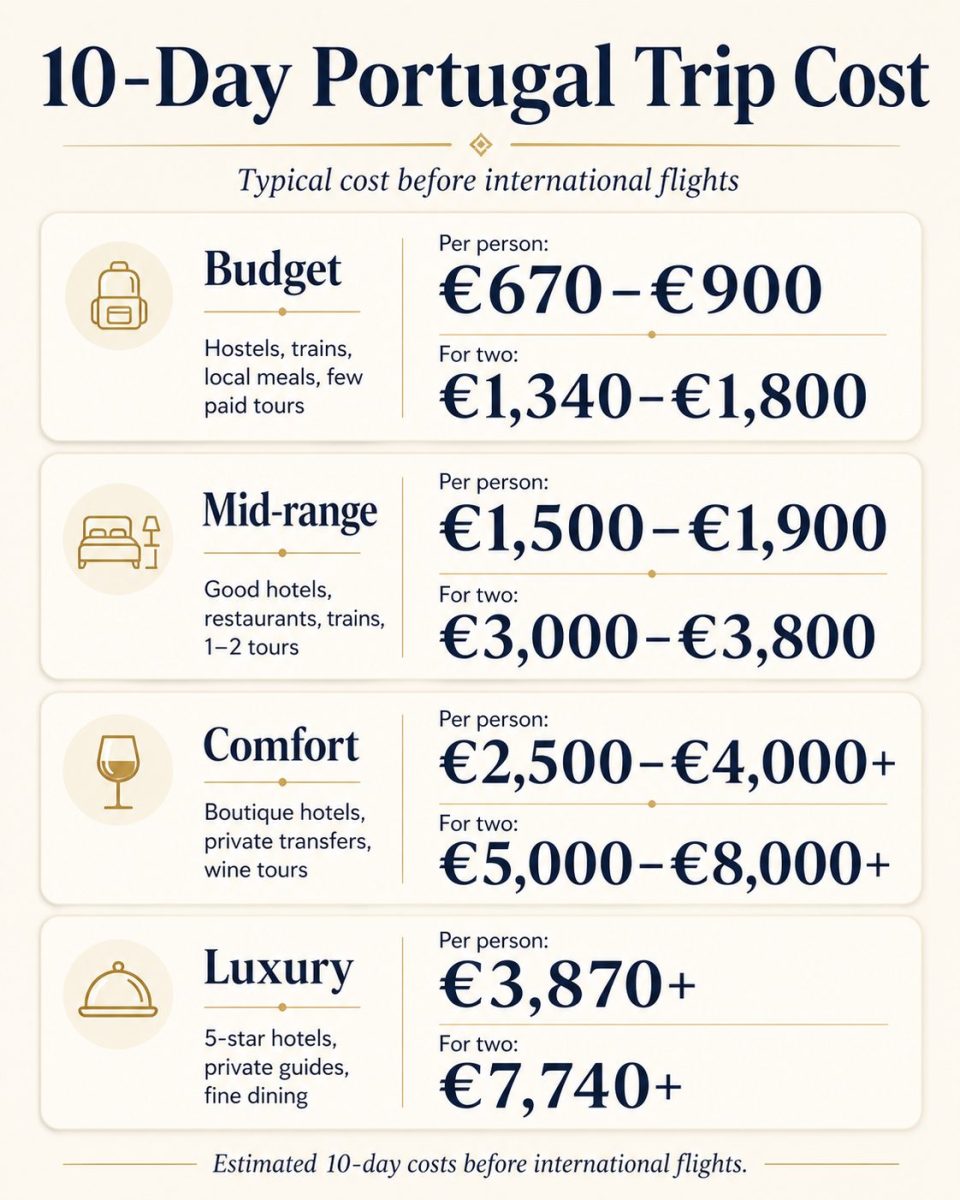
The cleanest way to estimate a 10-day Portugal budget is to split the trip by travel style. A budget traveler uses hostels, simple guesthouses, trains, local cafés, and fewer paid tours. A mid-range traveler books private rooms or good hotels, eats out often, visits major sights, and adds a Sintra day trip or a food tour. A comfort traveler starts using boutique hotels, private transfers, wine tours, better restaurants, and flexible logistics that make the day feel smoother.
| Travel style | Cost per person | Cost for two | Typical trip style |
|---|---|---|---|
| Budget | €670–€900 | €1,340–€1,800 | Hostels, simple rooms, trains, local meals, few paid tours |
| Mid-range | €1,500–€1,900 | €3,000–€3,800 | Good hotels, restaurants, trains, paid sights, 1–2 tours |
| Comfort | €2,500–€4,000+ | €5,000–€8,000+ | Boutique hotels, private transfers, wine tours, better restaurants |
| Luxury | €3,870+ | €7,740+ | 5-star hotels, private guides, fine dining, premium experiences |
These estimates sit before international flights. That matters, because airfare behaves badly. A traveler flying from London or Madrid may find a cheap return fare without much drama. Someone flying from New York, Toronto, or Los Angeles can spend enough on flights to reshape the whole Portugal travel budget before the first train ticket is booked.
What Is Included in This 10-Day Portugal Budget?
This budget covers the actual cost of traveling inside Portugal once you arrive. It includes accommodation, food, drinks, public transport, intercity travel, attractions, day trips, and a small buffer for the little costs that always appear: luggage storage, snacks, tips, taxis, toiletries, water, and the second coffee you definitely did not plan to buy.
It does not include international flights, travel insurance, major shopping, visa or passport costs, expensive nightlife, or luxury splurges such as Michelin-starred dining and private yacht charters. Those need their own line. Mixing them into the core daily budget makes the estimate muddy very fast.
For a clean estimate, calculate Portugal costs before flights first. Then add airfare based on your departure city and travel dates.
10-Day Portugal Cost Breakdown
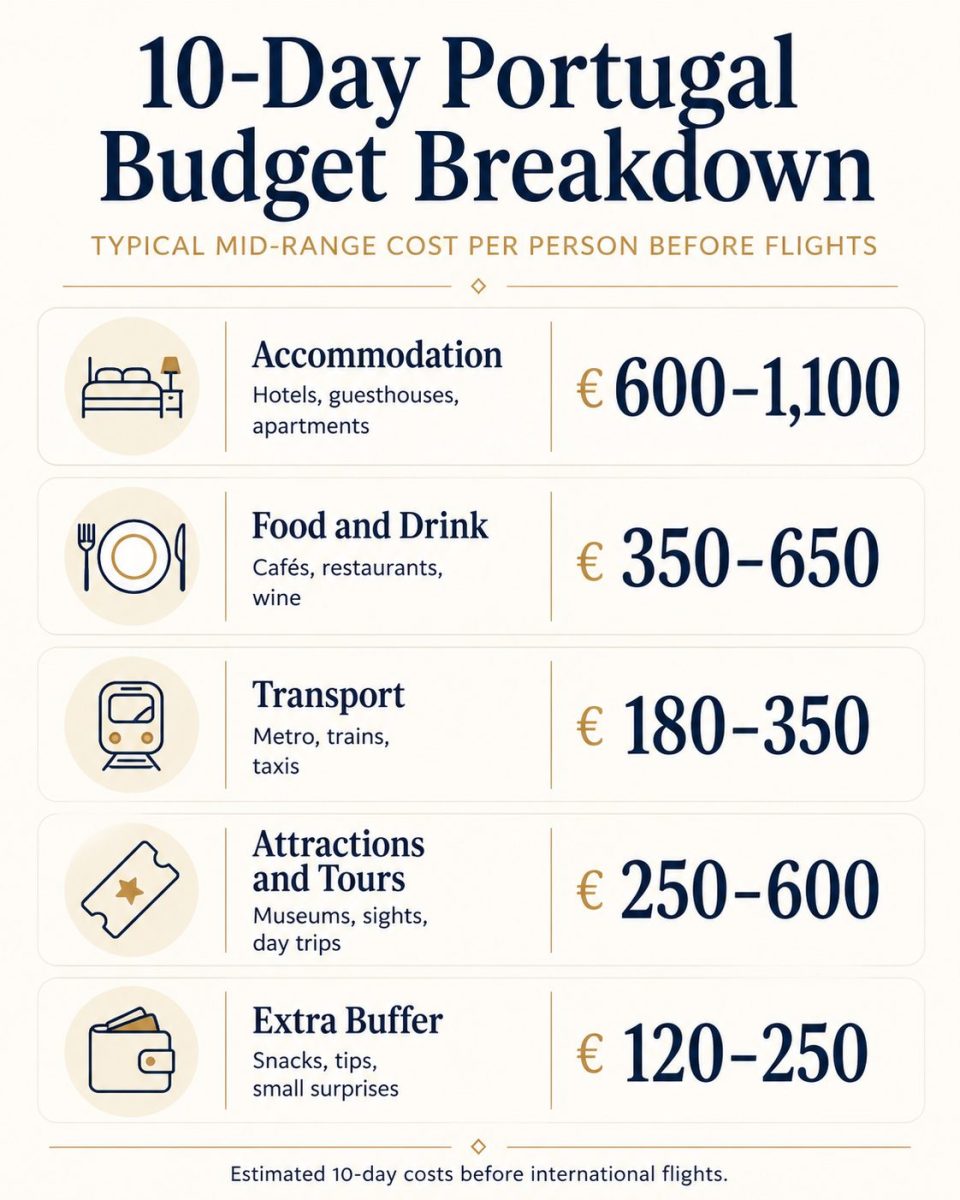
A 10-day Portugal trip is usually shaped by five spending categories: accommodation, food, transport, attractions, and extra buffer money. Accommodation is normally the biggest variable. Food can stay reasonable if you use local cafés and lunch menus. Transport stays manageable with trains, then rises quickly once car rental, tolls, parking, or private transfers enter the route.
| Category | Budget | Mid-range | Comfort |
|---|---|---|---|
| Accommodation | €250–€600 | €600–€1,100 | €1,300–€2,500+ |
| Food and drink | €200–€350 | €350–€650 | €700–€1,300+ |
| Transport | €70–€180 | €180–€350 | €400–€1,200+ |
| Attractions and tours | €70–€200 | €250–€600 | €800–€2,000+ |
| Extra buffer | €80–€150 | €120–€250 | €250–€600+ |
Accommodation
Accommodation is the first place where a 10-day Portugal budget either stays sane or cracks open. Hostels and simple guesthouses can keep a budget trip low, especially in Porto, Coimbra, Braga, and inland towns. Lisbon, central Porto, the Algarve in summer, the Douro Valley, Madeira, and boutique coastal stays are another conversation.
For a mid-range trip, assume private rooms or modest hotels. If two people share, the per-person cost feels reasonable. If you travel solo and want hotels rather than dorms, your daily cost jumps. A €140 room is €70 each for two people. Alone, it is still €140. No amount of clever planning changes that math.
Food and Drink
Food in Portugal can still be excellent value if you avoid eating every meal in tourist-heavy streets. A coffee and pastry breakfast is cheap. A local lunch menu can feel generous. A casual dinner with house wine may still seem merciful compared with northern Europe or the United States.
The budget changes when every dinner becomes a polished restaurant meal, every afternoon includes cocktails, and every city stop adds a food tour, wine tasting, or fado dinner. Those can be worth paying for. I like a good food tour early in a trip—well, a good one, not a bored guide reciting bacalhau facts from a laminated script—but it has to be counted as an experience, not an invisible extra.
Transport
For Lisbon and Porto, public transport is usually the best value. Trains are often the easiest way to move between Lisbon, Porto, Coimbra, Braga, Aveiro, and Faro. Renting a car for all 10 days rarely makes sense if most of the trip is city-based.
A car becomes more useful in the Algarve, Alentejo, the Douro Valley, Madeira, the Azores, and rural areas where train coverage is limited or slow. Even then, it is often smarter to rent only for the section that needs it. Ten full days of car rental, fuel, tolls, insurance, and parking can quietly drag a mid-range trip into comfort-priced territory.
Attractions, Tours, and Day Trips
Portugal does not force you to spend heavily every day. Viewpoints, riverside walks, churches, markets, beaches, tiles, cafés, and old streets can fill hours without a serious ticket bill. The paid side appears when the itinerary starts collecting Sintra palaces, major monuments, food tours, wine tours, boat trips, cellar tastings, and private guides.
For 10 days, one or two paid experiences usually make sense. A good food tour early in Lisbon or Porto can help you order better for the rest of the trip. A Douro Valley tour can solve the transport problem and turn a complicated wine day into something easy, with port lodges, quintas, schist terraces, and proper tasting context instead of guesswork. The mistake is stacking paid tours every second day and then acting surprised when the trip stops feeling affordable.
How Much Does a 10-Day Portugal Trip Cost for Two People?
A realistic mid-range 10-day Portugal trip for two people costs around €3,000–€3,800 before international flights. That covers shared accommodation, restaurants, trains, local transport, paid sights, and one or two guided experiences. A comfort-focused version can reach €5,000–€8,000+ if the itinerary includes boutique hotels, private transfers, Douro wine experiences, Algarve summer prices, or several guided tours.
Couples usually get better value than solo travelers because some costs are shared. Hotel rooms, taxis, car rental, fuel, parking, and private tours often cost less per person when split. Food, museum tickets, train tickets, and tasting fees still double. There is no magic in the bill.
Sample 10-Day Portugal Budgets by Itinerary
The route matters as much as the hotel category. A 10-day Portugal itinerary based on Lisbon, Porto, and Coimbra is not priced the same as Lisbon, Porto, and the Douro Valley. Add the Algarve in August and the hotel logic changes again, sometimes brutally.
| Route style | Estimated cost | Best route idea |
|---|---|---|
| Budget | €670–€900 | Lisbon, Porto, Coimbra or Braga, mostly trains and local meals |
| Mid-range | €1,500–€1,900 | Lisbon, Porto, Sintra, and Douro or Algarve add-on |
| Comfort | €2,500–€4,000+ | Lisbon, Porto, Douro Valley or Algarve, boutique hotels and tours |
Budget Route: Lisbon, Porto, Coimbra or Braga
This is the cheapest sensible version of a 10-day Portugal trip. Spend several nights in Lisbon, take the train to Porto, then add Coimbra, Braga, or Aveiro instead of a high-cost region. The route stays rail-friendly, avoids long car rental, and still gives a real view of Portugal beyond the two big city stops.
This version works best for travelers who enjoy walking, local restaurants, bakeries, free viewpoints, markets, churches, tiled streets, and a slower pace. It works less well for someone who wants private transfers, beach resorts, wine estates, and daily guided experiences.
Mid-Range Route: Lisbon, Porto, Sintra and Douro or Algarve
This is the classic first-timer version. Lisbon gives museums, neighborhoods, food, viewpoints, and easy access to Sintra. Porto adds the riverfront, port cellars, tiled churches, and a very different northern mood. The final section can point toward the Douro Valley for wine and scenery or the Algarve for coast and beaches.
This is also where the average 10-day Portugal cost usually lands: around €1,500–€1,900 per person before flights. The range depends on hotel quality, season, and how the third region is handled. A self-guided Douro day by train is one thing. A private wine tour with tastings and lunch is another.
Comfort Route: Lisbon, Porto, Douro Valley or the Algarve
The comfort version spends more because it removes friction. Better hotels. Airport transfers. Private guides. Wine tastings arranged properly. Maybe a driver in the Douro. Maybe a car for the Algarve. Maybe restaurants chosen for the room, the cellar, the view, not the price.
There is nothing wrong with this version. Portugal handles comfort travel beautifully. Frankly, the Douro with a good driver and a proper quinta lunch can be far better than fighting train times and taxi gaps. But the budget should be honest from the start. A 10-day trip with boutique hotels, private transport, wine country, and better restaurants is not a €1,000 trip, even if Portugal still gives strong value.
10-Day Portugal Cost by Destination
Portugal looks small on a map, but costs shift sharply by region. Lisbon is not priced like inland Alentejo. Porto is not priced like the Douro Valley. The Algarve in February is not the Algarve in August.
Lisbon is usually the most expensive city stop on a first Portugal itinerary. Hotels, restaurants, airport transfers, Sintra day trips, and major sights all push the daily budget upward.
Porto can be better value than Lisbon, though prices have risen in the most central areas. Wine tastings, port cellars, river cruises, and Douro trips can raise the total quickly.
The Algarve can be reasonable outside peak months and expensive in summer. Hotels, beach towns, boat trips, car rental, and family resort demand drive the difference.
The Douro Valley is a special case. It can be affordable if you travel independently, take the train, and keep tastings simple. It becomes expensive when the plan includes wine hotels, private drivers, curated tastings, and long lunches at estates where the view over the terraces quietly does half the selling. Madeira and the Azores also need extra budget room for flights, car rental, weather-dependent tours, and island logistics. Alentejo can be better value, but a car is often needed to enjoy it properly.
What Makes a 10-Day Portugal Trip More Expensive?
The biggest mistake is assuming that Portugal is automatically cheap everywhere. It is not. The country can still be excellent value, but certain choices push the budget upward straight away.
- Traveling in July, August, or early September
- Booking Lisbon, Porto, or Algarve hotels late
- Using private transfers instead of trains and public transport
- Renting a car for all 10 days when only part of the trip needs one
- Adding Sintra, Douro, Algarve boat tours, food tours, and wine tastings
- Staying in boutique hotels in the Douro Valley or coastal resort towns
- Traveling solo but choosing mid-range hotels every night
- Eating every meal in tourist-facing streets instead of mixing in local cafés
How to Save Money on a 10-Day Portugal Trip
Saving money in Portugal does not mean making the trip dull. It means spending on the experiences that matter and avoiding expensive conveniences that add little. A train between Lisbon and Porto is not a downgrade. A local lunch can be better than a polished tourist restaurant. A hotel near a metro station can be smarter than a cramped room on the most famous street.
- Use trains between Lisbon, Porto, Coimbra, Braga, Aveiro, and Faro.
- Rent a car only for the Algarve, Alentejo, Douro, Madeira, or Azores section.
- Travel in March, April, November, or early December for better hotel value.
- Book accommodation early for May, June, September, and October.
- Eat bigger lunches at local restaurants and keep some dinners simple.
- Choose one strong guided experience instead of several average tours.
- Stay near public transport instead of paying only for a famous address.
- Keep a daily buffer so small costs do not feel like budget failure.
Is 10 Days in Portugal Enough?
Ten days in Portugal is enough for a strong first trip, but not enough for the whole country. The best version usually includes Lisbon, Porto, and one extra region. That extra region might be Sintra and Cascais, the Douro Valley, Coimbra and Braga, the Algarve, Alentejo, Madeira, or the Azores.
The mistake is trying to fit everything into 10 days. Lisbon, Porto, Sintra, Douro, Algarve, Madeira, and the Azores in one trip is not ambitious. It is expensive and exhausting. Pick a clean route. Leave something for the next visit.
FAQ
Is €1,000 enough for 10 days in Portugal?
Yes, but only for a careful budget trip. €1,000 can work if you stay in hostels or simple rooms, use public transport, travel by train, eat local meals, and limit paid tours. It is tight for central Lisbon hotels, Algarve summer stays, private transfers, wine tours, and restaurant-heavy travel.
How much spending money do I need for 10 days in Portugal?
Most mid-range travelers should plan around €1,500–€1,900 per person before international flights. That covers accommodation, food, local transport, intercity trains, sightseeing, one or two tours, and a modest buffer.
How much does Portugal cost for two people for 10 days?
A realistic mid-range 10-day Portugal trip for two people costs around €3,000–€3,800 before flights. Comfort-focused trips can reach €5,000–€8,000+ with boutique hotels, private transfers, Douro wine tours, Algarve beach stays, and better restaurants.
Should I rent a car for 10 days in Portugal?
Usually not for the full 10 days. A car is useful for the Algarve, Alentejo, Douro Valley, Madeira, the Azores, and rural areas. For Lisbon, Porto, and train-connected cities, public transport and trains are usually easier and cheaper.
What is the cheapest 10-day Portugal itinerary?
The cheapest sensible route is usually Lisbon, Porto, and Coimbra or Braga, using trains and public transport. This avoids long car rental, expensive resort areas, and high-cost wine-country logistics while still giving a varied Portugal trip.
Is Portugal expensive for food and drink?
Portugal can still be very reasonable for food and drink if you use local cafés, bakeries, lunch menus, and neighborhood restaurants. Costs rise in tourist streets, beach resorts, wine bars, fine dining restaurants, and organized food or wine experiences.
Should I include the Algarve in a 10-day Portugal budget?
Yes, if beaches are a priority. Just remember that the Algarve is highly seasonal. It can be good value outside peak months and expensive in July and August, especially if you need car rental, beach-town hotels, and boat tours.
Final Takeaway
A 10-day trip to Portugal usually costs around €1,500–€1,900 per person before international flights for a mid-range traveler. Budget travelers can spend less by using simple accommodation, trains, local meals, and fewer paid tours. Comfort travelers should expect much more, especially with boutique hotels, private transport, wine country, or peak-season coast.
The cleanest way to plan is simple: choose Lisbon, Porto, and one extra region. Then price that third region honestly. Coimbra or Braga keeps the budget calmer. The Douro Valley, Algarve in summer, Madeira, or the Azores can make the same 10 days feel much more expensive. Portugal still offers strong value. It just rewards travelers who understand where the money goes.
You have not enough Humanizer words left. Upgrade your Surfer plan.